
|
|
||

Also
In This Issue:
“Shine Up Your Wheel- chair and Travel”
by Gail Genereau
Bits & Pieces:
Invacare Recall Creed to Live By, Vaccine Injury Compensation,
Tray for Scooter
The P.E.N. & ink Link
I Thank God That I Got Pneumonia
By Marian Zoesch with Elinor Young
P.O.S. Library
Our Offer (for a mailed subscription)
Copyright information
Feature Article:
Assistive Devices: How One Occupational Therapist with Post-Polio Syndrome Compensates
By Sandy Matsuda, PhD, OTR/L. School of Health Professionals and School of Medicine, University of Missouri-Columbia
(Part of an article. The whole original is at www.hsc.missouri.edu/~shrp/vhctwww/case499/index.shtml.)
Introduction
Last year a faculty member at the School of Health Professions called Nancy Caverly, an Occupational Therapist in Bland MO, and asked if she could mentor an OT student.
Nancy said “Yes, I’ll take a student” and added, “she can stay with us on the farm since we’ll be starting early in the morning for my first school.”
Nancy is one of several rural therapists who serve as mentors and clinical supervisors to OT and PT students.
Nancy mentored Susan, a junior OT student from St. Louis. She had never seen rural and pediatric practice. With Nancy she saw both. She also saw how Nancy lived with the effects of post-polio syndrome.
Opening Viewpoints
Student: Transporting testing and therapy equipment is a challenge for anyone providing OT services in rural settings! How does Nancy manage time, energy and resources to treat children during the week and accommodate guests on weekends?
Client: I have been able to achieve many dreams because of my disability as well as in spite of it. My ability to adapt and problem solve has been sharpened by necessity and by the profession I chose after having polio at age 17. I may take a different perspective and approach at times but I’ve also had experiences that make me empathetic, resourceful, and creative in my approach to others and to living.
Physical Therapist: Some of the mobility aids that work in urban areas don’t work in the country. What kind of wheelchair, cart, or small vehicle is most useful?
Occupational Therapist: What lifestyle changes will make Nancy’s retirement dreams more reachable? What adaptations to a modular home and a 19th century farm house are practical and esthetically pleasing? What tools and adaptations make gardening, cooking, and leisure activities on a bed and breakfast farmstead easy and fun to perform?
Orthotist: During Nancy’s acute polio period in the 1950’s, the mark of successful rehabilitation was to throw away orthotics and assistive devices. Now many persons with post-polio syndrome (PPS) have to reassess. Their previous reliance on compensatory movement may now be taking a toll in terms of energy, pain, and fatigue. For Nancy, genu recurvatum, or ‘back-kneeing,’ has been her compensatory movement for walking. Now it is causing transient back pain and instability for which a brace has been prescribed. Custom-made orthotics for the shoes help other people relieve back pain and fatigue. An ankle-foot orthosis can help correct foot drop and prevent the need to lean forward to watch the floor when walking.
Social Worker: Nancy is fortunate to have a profession and retirement plans that allow her financial stability. Many adaptive devices are expensive and require outside funding such as the state division of vocational rehabilitation, private insurance, and supplemental security income or small grant and non-profit organizations. Sometimes the greatest adjustments for people with post-polio are not just the physical losses. The financial, psychological, and self-esteem issues are often tied to reduced or lost employment and the hardships of being on disability. I could help Nancy address some of these issues and also support her in her active participation in the International Polio Network.
By restoring an old farm house to a bed and breakfast that is accessible, Nancy and her husband have given our community a gift which strengthens the schools, community businesses, churches, and services. Nancy has been a strong advocate for persons with disabilities, and knows first hand the struggle to be a productive working taxpayer. My job is to help her find the resources to continue her personal and social quest which benefits our community and strengthens the quality of life for all of us.
Assistive Devices
Armed with cameras and curiosity, three students visited the Caverly’s. They wanted to capture first-hand the flavor of this therapist’s lifestyle (not to mention her homemade scones and pear preserves). The students were greeted by Nancy standing on the ramp outside the Caverly’s temporary modular home. Inside the front door, Nancy props her wooden “country” cane on the back of an antique chair. A plexiglass “city” cane hangs from a shelf of cookbooks in the kitchen. Nancy tells how little children often ask if her cane is made of glass. She tells them, with a twinkle in her eye, that she fills it with water and keeps her goldfish in it. Nancy uses a Swedish-made wheeled walker in her kitchen for multiple purposes. Her balance and endurance have declined due to post-polio syndrome. The walker, with a built in basket, tray and bench allows her to carry garden squash, roast pork tenderloin, and fresh baked bread to the table. She sits on the walker’s built-in bench to save energy for two of her passions: gardening and cooking. Susan returned to the Caverly’s farm on another visit, along with Joan Crosby who will be doing a clinical in the area soon. On this trip, they learn how Nancy is adapting her home and lifestyle to adjust to the physical changes caused by post-polio syndrome. Nancy shows them the “green machine,” a John Deere 5-wheeler, that allows her to travel around the 57-acre farm to her garden and up the hill to the old 1850’s farm house they restored for the Bed and Breakfast The original log beams and inner stone walls with grass growing in the cracks still show but so does Nancy’s knowledge of accessibility. Ramps, levers on door handles, and safety features in the bathroom will make life easier for Nancy and her guests. Stair chairs carry her to the second floor guest rooms and down to the basement where she weaves on a floor loom. Her husband, David, takes her ideas and finds a way to construct them. Some simple things, like the hot-dog roasting stick reacher her son made for the fireplace, have dual functions. Nancy uses it to retrieve baskets from where they hang in the kitchen. A basket and a shoulder bag allow her to carry objects using her trunk and arm while keeping one hand free to use her cane. “It is evident that Nancy is dedicated to the welfare of children and the field of occupational therapy,” Susan observes. Nancy’s own experience of living with disability from a young age has heightened her sensitivity towards the needs of others with disabilities. She has just returned from three days at the Governor’s 2nd Annual Missouri Conference on Disability Rights and is wearing a button that says: “I have a disability and I vote.”
She is not shy about questioning the student’s use of the term “confined to a wheelchair.” “Do you know anyone who has to sleep in her wheelchair?” she asks playfully. She explains how her wheeled scooter saves her energy and frees her rather than confines her.
Client’s Comments
Since opening our Bed and Breakfast, we have met over 100 guests from Missouri and surrounding states. I work three days a week in my profession of occupational therapy, visiting young children with special needs in their homes. I service children in two school districts. My work days are 8-10 hours long, much of the time spent driving my Blazer. A car phone gives me security if I have a flat tire, and the ability to contact a family from my vehicle. In May, 1997, I fell in my bedroom while holding on to a cane and the bed. As I squatted down after losing my balance, I felt a snap, crackle and pop in my left knee. A quick trip to St. John’s Mercy Hospital in St. Louis confirmed my worst fears–a comminuted fracture of the left patella. After open reduction, with epidural anesthesia, I returned home to the country 18 hours after surgery, with a full leg canvas splint and a large ice bag. With a rental wheelchair, a new pair of forearm Lofstrand crutches, and gentle assistance from my daughter and husband, I had a speedy recovery. Ten days later, I presented three times at the International Post Polio Conference and Independent Living Conference in St. Louis. It was not easy, moving on carpeting in the wheelchair, or walking on crutches for the first time in many years. A course of physical therapy to strengthen the muscles supporting the joint and to regain the flexion I had before the fall followed for about 6 weeks. I have been walking with one or two crutches since the fall, finding I have more support from a crutch than from a cane. Using both crutches when shopping where people are around me provides security. I use the crutches for support, though I can move about my home, using the walls or furniture as props. I am not using the expensive full leg brace made for me, as the crutches provide the support I need. Ultra-light crutches are available now, and I’m hoping to get a pair soon–and they come in designer colors! I work in the gardens, modifying my movements according to where the plants are, putting in seeds or trimming bushes. The John Deere “green machine” moves me about our farm. I pick wildflowers in the field, gather rocks from the creek bed to border flower gardens, and drive our grandsons around to find turtles and deer tracks. There are always more tasks than time, but the balance of three days away from the farm working, and the long weekend for guests is reasonable at this time.
I plan to continue with the First Steps program and my school districts for two more years, until I become a legitimate senior citizen at 65. I would like to develop a treatment program on our farm, emphasizing wellness using myofascial release techniques I have learned in several seminars. It seems that rural folks do not have ready information about the concept of wellness, particularly nutrition and exercise. Perhaps I can serve individuals in the rural communities nearby and maintain my professional connection.
Conclusion
Nancy has lived with her disability for 43 years. She is comfortable letting students assess her muscle strength, analyze her gait, observe her activities of daily living and her adaptations. She advocates a transdisciplinary team approach to assessment. She uses a transdisciplinary model in her early intervention cases and says it could be used with adults as well. There is no need to ask a person to repeat the same medical history to the physician, social worker, and therapists, according to Nancy. She also suggests that new therapists who were not alive at the time of the original polio epidemic listen to the wisdom of their patients before giving advice. By putting her story on the Virtual Health Care Team®’s home page, Nancy is helping to educate the next generation of students at MU.
____________________________
Copyright © 1998-2001 The Curators of the University of Missouri. All rights reserved. Used with permission.
Downloaded 07/17/01 from www.hsc.missouri.edu/~shrp/vhctwww/case499/index.shtml.
For permission to reprint, see the above Website for the appropriate contact source.

“I have had dreams and I have had nightmares, but I have conquered my nightmares because of my dreams” – Dr. Jonas Salk

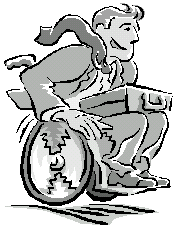 Shine Up Your Wheelchair and Travel!
By Gail Genereau, who is off on another adventure
I don’t want anyone to think it’s easy to travel. I sometimes plan a year ahead. It is much easier now with the “net” but it still takes lots of planning. It is also more costly to travel with a disability. I can no longer stay at all the lovely B&Bs (bed and breakfast accomodations) that I liked a few years ago. I can no longer do stairs and most B&Bs have stairs. Last July I attended genealogy classes at the University of York in Yorkshire, England. I took my hefty, strong sister along to help. She’s my #1 best “adaptive aid” if my husband cannot go with me. I have several friends who fit this category. ☺ She managed well with my chair all over, even on the cobblestones of the Shambles. We tried to stay in University housing. All rooms were singles. She moved her mattress into my room and slept on the floor. We stored the luggage and chair in her room. We only managed three nights like this. The bathroom was down the hall and it only had a tub; no shower. She rigged up a hose from my vent hoses to make a shower but it wasn’t the most convenient. I only weigh 80 pounds so she was able to lift me in and out of the tub but it was just too exhausting for me. So we moved to a full service hotel. I had e-mailed hotels and inns ahead of time so I knew the options available to us. I always have Plan B in case Plan A doesn’t work out. Plan A in this case was much cheaper but just didn’t work out. I had inquired of several hotels beforehand. Everyone was so helpful. People even measured toilet height for me. Plan B turned out just fine. I also take out travel insurance when planning each trip. Two years ago, I had planned a trip and contracted E-coli, here in Wisconsin, and was unable to travel. The insurance covered all the cancelled airfares and tour deposits, etc. I also carry insurance that will fly me back to the US if I need to be airlifted for medical care. Of course, I don’t do all this when just traveling in the USA or in countries that have a high standard of living. I usually try to travel in the “off” season when possible. I also try not to travel in hot and humid seasons. But sometimes these areas and times cannot be avoided. I also no longer travel to “third world” countries. I usually contact other polio survivors in the areas that I am going to visit. They are a great source of info and always willing to offer advice in an emergency. I carry double amounts of all medications, spare parts for the chair and vent; extension cord, plug adaptors, voltage transformers, syringes, antibiotics, tool kit, medical records, and sometimes x-rays, etc. I have had a few medical adventures in foreign countries but nothing that couldn’t be handled locally. A large flag pole blew off a building in Vienna and knocked me to the ground. I was x-rayed and nothing was fractured. I have had nose bleeds and trouble breathing on several long flights but there was always a doctor or nurse on board to help. If not, my traveling companion would always be aware of what to do if I were unable to speak. We always plan ahead for things like this. If traveling very long distances, I plan more stops now. I used to try to fly non-stop but now I find it easier to stop and make a connecting flight. It helps even if we only stop for an hour or two. Just to breathe fresh air is a big relief after hours of recycled air.
If I can help anyone with travel questions, please e-mail me privately. I will do my best to help. I know what has worked for me but it may not work for everyone. There are also special tour companies for people with disabilities. When I can no longer do it my way, I will look into them.
Keep rolling
,
Gail Genereau, Appleton, Wisconsin.
__________________________________
For more helpful hints, see “
Air Travel Tips for the Wheelchair or Scooter User,” by Dave Graham. You may download it from www.polionet.org/AirTravel/.
Bits and Pieces
Recall Announcement
There is a recall for Invacare power chairs sold between 1988 and June 2000. Invacare has recently discovered that, on rare occasion, an electrical short may occur that is not protected by its existing 60 amp fuse. In order to insure the safety of our products, additional 15 amp fuses have been designed into the system. Invacare power wheelchair owners should contact the dealer from which the chair was purchased to have the replacement kit installed.
If you cannot locate your original dealer, please contact Invacare corp. at 1-800-333-6900 and select option 8. They will direct you to an Invacare service center.
_____________________________________________
A Creed to Live By
Do not undermine your worth by comparing yourself with others.
It is because we are different that each of us is special.
Do not set your goals by what other people deem important.
Only you know what is best for you.
Do not take for granted the things closest to your heart.
Cling to them as you would your life, for without them, life is meaningless.
Do not let your life slip through your fingers by living in the past nor for the future.
By living your life one day at a time, you live all the days of your life.
Do not give up when you still have something to give.
Nothing is really over until the moment you stop trying.
It is a fragile thread that binds us to each other. Do not be afraid to encounter risks.
It is by taking chances that we learn how to be brave.
Do not shut love out of your life by saying it is impossible to find. The quickest way to receive love is to give love; The fastest way to lose love is too hold it too tightly;
In addition, the best way to keep love is to give it wings.
Do not dismiss your dreams. To be without dreams is to be without hope;
To be without hope is to be without purpose.
Do not run through life so fast that you forget Not only where you have been, but also where you are going.
Life is not a race, but a journey to be savored each step of the way
Author unknown
_____________________________________________
The Vaccine Injured Children’s Compensation Act of 2001
This bill was introduced on March 28, 2001, HR 1287, in the House of Representatives by Congressman Dave Weldon (R-FL) and Congressman Jerrold Nadler (D-NY).
This legislation will help families who are trying to get compensation for their children, including compensation for all the handicap aids such people need. You can call your Washington DC legislators at 202-224-3121 and ask for your member of Congress. If any of the provisions in this bill have a direct bearing on your ability to receive compensation for your child, relate your story to the staff member.
_____________________________________________
A Tray For Your Scooter
My scooter has a front basket attached to the tiller, but you could use this on a back basket as well. I made a portable tray to hook onto the rim of the basket (when in use) and to hang down flat against the inner side of the basket when not in use.
It was real simple and fun to make.
1- First, I went to the craft store, and bought picture frame side pieces that, when fitted together, would rest nicely on the top of the basket.
2- Then I bought two pieces of plastic canvas – the needle craft kind, a nice pattern book, and the yarn I needed to do the pattern.
3- I cut the canvas to fit the bottom of the assembled frame.
4- I worked the pattern on one canvas, in one set of colors, and the other canvas in another set of colors.
5- When the canvases were complete, I put the wrong sides of the needlepoint together, so the pretty sides would show on both the bottom of the tray, and on the inside of the tray.
6- I nailed the back-to-back canvases to the frame, and did a yarn whipping around the frame (if I do a new one, I think I will just glue fabric around the frame).
7- The final effort was to screw in cup hooks to one of the long sides of the frame. The hooks keep the ‘tray’ in place on top of the basket (when in use as a tray), or when lying against the inner edge of the basket.
This little custom made tray has been great for dining at food courts, carrying food to seating areas at picnics and buffets. It is also great as a writing tablet, and a place to prop a book for reading.
—Sandi
 WEB FINDS
Are you a full-time wheelchair user? Finding it hard to get jeans or pants that fit right sitting down? Try USA Jeans Wheelchair Clothing at wheelchairjeans.com. They say, “USA Jeans are designed to look good while sitting, just as standing pants are designed to look good standing up.” They are also designed in such a way to prevent pressure sores. USA Jeans claims to be reasonably /low priced.
The National Council on the Aging created BenefitsCheckUp, at benefitscheckup.org, to help older and disabled adults quickly identify programs that may improve the quality of their lives. It only takes 10-15 minutes, and you may find you are eligible for programs you didn’t know about – like help with property taxes or home weatherization. They say, “Chances are, you will be surprised to learn what benefits are available to you, regardless of your income.” Can’t hurt to check.
Reports are available from “International Conference on Post-Polio Syndrome: Identifying Best Practices in Diagnosis and Care” held at Warm Springs, Georgia, May 2000, sponsored by March of Dimes. To obtain a free copy of the condensed report in brochure form, download from the March of Dimes at: http://www.marchofdimes.com/files/p-psbro.pdf
With the resumption of the school year, you may have grandchildren or others who come to you for information to do a report on polio. The following would be very good places to point them to:
View a slide show on the global effort to eradicate polio on the Bill and Melinda Gates Foundation Web site at www.gatesfoundation.org/globalhealth/polio/default/.
You can find a very interesting gallery of photos at w3.whosea.org/tcg/calcutta/photo/ph_polio/. Titled “Polio: The Disease, The Virus, The Vaccine,” it even includes a photo of an ancient Egyptian stele depicting a polio-afflicted priest, Circa 3000 BC.
P.E.N. & ink Link
About our Website:
“I received an e-mail from (a friend) notifying me that her father-in-law passed away from Polio. I have never heard of the syndrome nor its history and how it came to existence. I therefore used a search engine and stumbled upon your wonderful website. It provided a brief definition of what polio is that helped me understand a great deal about the syndrome. I also kept looking through your website and I found it one of the most resourceful websites I have ever come across (providing patients and families with support groups and even students with links for research!). I do hope that there are many more websites like yours out there.”
About “P.E.N. & i
nk”
“Thank you for your encouraging and inspirational newsletter. I do not have PPS, but am disabled with sever chronic pain caused by spinal stenosis and arachnoiditis. The same help you receive from Jesus is there for me too!” – A.
“I have a signed photograph of Elizabeth Kenny by Yusef Karsh that has been in my family for years. I am willing to sell it to a good home. Please contact me with names and phone numbers (or e-mail addresses) of anyone who would be interested. Thank you very much.” Roslyn Corson-Willett 561/745-5617 Phone & Fax
561/222-8099 Cell & Voicemail

I Thank God That I Got Pneumonia
By Marian Zoesch with Elinor Young
Pneumonia is a disease that can stop a person in one’s tracks, one that can come on you suddenly. It happened to me this spring. I developed a cough on Good Friday, felt sick to my stomach on Easter Sunday, and by Wednesday I decided I needed to see a doctor. I cancelled my six-hour volunteer time on Friday for an appointment. Meanwhile, on Thursday, I spoke at a women’s group and worked with the children’s program at my church. When I finally got to the doctor, he told me that I had bronchitis, and ordered chest X-rays. Saturday morning could not get out of bed so I called my sister for help. She helped me get dressed and into my wheelchair so I could go to a hospital emergency room. The “bronchitis,” it turned out, was pneumonia. They kept me – for nine days. They wanted to discharge me after a week, but it was evident that I would be unable to get up and around on my own in my apartment. Because I also have post-polio, it was suggested that I go to St. Luke’s Rehabilitation hospital to get my strength back. What a blessing! During my nine days there, for the first time my PPS problems were addressed. I was thumped on my back in the lung area three times a day to loosen material that had been collecting for years. Under their coaching, I learned how to properly cough to keep my lungs clear. One of our support group friends, Faye, came to visit. I told her that I was having problems sleeping at night. I always have. After I described the “creepy crawling feeling” throughout the night, (my legs wanted to move constantly but lacked the muscle power), Faye suggested that part of the problem might be Restless Leg Syndrome. I questioned a doctor about it and was given a medication that now allows me to lay comfortably in one place for more than ten minutes! What a relief! It was also discovered that I have sleep apnea. I will be having a formal sleep therapy test to see if I need oxygen at night. Not only was I looked over, so was my equipment. My wheelchairs were evaluated and I am scheduled to get a new power chair that fits correctly for me. My manual chair is also going to be remodeled to correct my sitting. But that’s not all! Before going into the hospitals, I was told by local public transport that I would no longer be allowed to use para-transport year round. From May to October I would have to use the fixed bus system. This would mean I would have to get on and off the bus twice going to one of the places I regularly volunteer. I would have to wait out on the streets at night then go several blocks to get home – all alone. When the post-polio rehab doctor at St. Luke’s found out about that, she “went to bat” for me and did all the paper work needed to allow me year-round use of para-transport. Could it get better? Could anything be added? How about this – with a smaller appetite due to the pneumonia, I lost twenty pounds!
Yes, I’m really glad I was forced to take time out from my going for, doing for and working with others and let others do and work for me as the center of attention.
Thank you, God. My pneumonia was a huge blessing!
***The information given in this newsletter is not meant to be medical, financial or legal advice and is not given by a medical or legal professional. We recommend that you seek appropriate professional counsel regarding any concerns.***
Polio Outreach of Spokane Library
Your resource for information on post-polio syndrome and disability issues.
Polio Outreach Of Spokane maintains a large library of information on post-polio syndrome and disability issues. The printed material is available by contacting our Librarian, Darlene Hansen at darleneh@cet.com
Remember, you are not alone in your struggle. The problems that you or your loved one are experiencing now have been dealt with by others in the past. Their experiences are documented in some great material, all available in our library. Give Darlene a call and tell her what your difficulties are. She can send you the appropriate material.
Our Offer:
If you want to receive PEN & ink by normal mail, send a request with your mailing address to:
P.E.N. S. 508 Shoreline Drive
Liberty Lake, WA 99019
We would appreciate a donation for printing and mailing costs, if you are able to do so. We have no source of funding other than our readers.