

Inspiration, news and knowledge from Polio Experience Network
No. 29: Summer, 1999
 …Sharman’s News
…”Hands,” (author unknown)
…Important Report from the Editor
…BUILDING YOUR MEDICAL TEAM – PART 4 , Taking Personal Responsibility or “You Want Me to Do What?” By Darlene Hansen
…The Way We Do It – guest column by Sylvia Smith
…Eaves-droppings from M.I.C., (alias Marion Zoesch)
…The P.E.N. & ink Link
…WEB FINDS
…………………………….. “A Boost Up,” By Elinor Young
………………………………Our Offer (for normal mail subscription)
………………………………P.O.S. Library
………………………………SOME TIPS are more useful than others ….
………………………………Copyright information
Sharman’s News
from Sharman Collins
Spring is here! I just love the fresh smell in the air. I hope you are enjoying the warm sunshine and the colorful blossoms of spring. Our new neighborhood offers my poodles and me lots of territory to explore.
I am looking forward to seeing you at our Polio Outreach meetings in the coming months. On April 27, my son, Ken Collins, D.D.S., will speak to us about the special concerns we with post-polio have when we visit a dentist. Also, he will address different ways we can improve our dental health. He is such a caring and personable young man, I know you will enjoy meeting him. With the remaining time we have after he is done, we will discuss other facets of dealing with post-polio syndrome.
On May 25, Reagan Dobler, Master Gardener, is excited to talk with us about gardening as a hobby. I met Reagan when we built our home as she did a lot of the landscaping. She loves gardening and her enthusiasm is contagious. Reagan is looking forward to sharing her ideas with us about container gardening, special tools or ideas for those with strength problems, etc. This will be a exciting meeting, so be sure and be there!
On June 22, Bob Paull, P.T., is returning once again to speak with us. He is one of our favorite speakers and is very knowledgeable about post-polio syndrome. Bob will speak with us about different techniques we can use to improve function such as breathing properly and correct positioning in sitting, lying, and standing. He will also show us some new neuromuscular exercises we can all do!
Our summer picnic will be on July 31 from 12:00 noon to 7:30 p.m. at Camp Caro in Spokane Valley. Locals will receive more information about the picnic at a later date.( I wonder who will win the scooter relay race this time? Be thinking about what event you would like to see in our “Scooter Olympics.”)
Meetings are at Shriners Hospital in the 5th floor auditorium at 6:00 p.m. Shriners is located at W. 911 5th Avenue. There is easy access from the free parking garage under the hospital. If you are able to join us for dinner in the 4th floor cafeteria, please be there by 5:00 p.m.
Much love from your friend,, Sharman 
Hands
Author unknown
Back in the fifteenth century, in a tiny village near Nuremberg, lived a family with eighteen children. Eighteen! In order merely to keep food on the table for this mob, the father and head of thehousehold, a goldsmith by profession, worked almost eighteen hours a day at his trade and any other paying chore he could find in the neighborhood.
Despite their seemingly hopeless condition, two of Albrecht Durer the Elder’s children had a dream. They both wanted to pursue their talent for art, but they knew full well that their father would never be financially able to send either of them to Nuremberg to study at the Academy. After many long discussions at night in their crowded bed, the two boys finally worked out a pact. They would toss a coin. The loser would go down into the nearby mines and, with his earnings, support his brother while he attended the academy. Then, when that brother who won the toss completed his studies, in four years, he would support the other brother at the academy, either with sales of his artwork or, if necessary, also by laboring in the mines.
They tossed a coin on a Sunday morning after church. Albrecht Durer won the toss and went off to Nuremberg. Albert went down into the dangerous mines and, for the next four years, financed his brother, whose work at the academy was almost an immediate sensation. Albrecht’s etchings, his woodcuts, and his oils were far better than those of most of his professors, and by the time he graduated, he was beginning to earn considerable fees for his commissioned works.
When the young artist returned to his village, the Durer family held a festive dinner on their lawn to celebrate Albrecht’s triumphant homecoming. After a long and memorable meal, punctuated with music and laughter, Albrecht rose from his honored position at the head of the table to drink a toast to his beloved brother for the years of sacrifice that had enabled Albrecht to fulfill his ambition. His closing words were, “And now, Albert, blessed brother of mine, now it is your turn. Now you can go to Nuremberg to pursue your dream, and I will take care of you.”
All heads turned in eager expectation to the far end of the table where Albert sat, tears streaming down his pale face, shaking his lowered head from side to side while he sobbed and repeated, over and over, “No …no …no …no.”
Finally, Albert rose and wiped the tears from his cheeks. He glanced down the long table at the faces he loved, and then, holding his hands close to his right cheek, he said softly, “No, brother. I cannot go to Nuremberg. It is too late for me. Look … look what four years in the mines have done to my hands! The bones in every finger have been smashed at least once, and lately I have been suffering from arthritis so badly in my right hand that I cannot even hold a glass to return your toast, much less make delicate lines on parchment or canvas with a pen or a brush. No, brother … for me it is too late.”
More than 450 years have passed. By now, Albrecht Durer’s hundreds of masterful portraits, pen and silver-point sketches, watercolors, charcoals, woodcuts, and copper engravings hang in every great museum in the world, but the odds are great that you, like most people, are familiar with onlyone of Albrecht Durer’s works. More than merely being familiar with it, you very well may have a reproduction hanging in your home or office.
One day, to pay homage to Albert for all that he had sacrificed, Albrecht Durer painstakingly drew his brother’s abused hands with palms together and thin fingers stretched skyward. He called his powerful drawing simply “Hands,” but the entire world almost immediately opened their hearts to his great masterpiece and renamed his tribute of love “The Praying Hands.”
The next time you see a copy of that touching creation, take a second look. Let it be your reminder, if you still need one, that no one – no one – ever makes it alone!
Important Report!
…..In February we mailed you an appeal letter. In it we explained our financial situation and the decisions we needed to make, especially regarding the future of P.E.N. & iNk.
…..As the Editor of PEN & iNk, it is my pleasure to report on the results of that appeal.
…..We were overwhelmed with your responses. We can’t thank you enough for the confidence in us that you have demonstrated with your donations and your letters of encouragement.
…..I am happy to announce that Polio Experience Network is back on firm financial ground and looking forward to the future!
Many of you offered some great ideas on ways to improve the newsletter and save on costs. We read and discussed them all. Here is what we have decided to do.
…..First, we must pare down our mailing list. In over four years of publishing, the mailing list has some folks who no longer need the newsletter or don’t read it. To help us know who truly wants P.E.N. & iNk, we have printed a clip-out box on page nine. It has your mailing address printed on the back. Please clip it out and send it back to us. If you want to continue receiving PEN & iNk we must receive that box from you now. It does not matter whether you have ever sent us a donation. If you read P&I, we want to provide it. So send in that form!
…..Secondly, we will be publishing quarterly. We will mail an issue each spring, summer, autumn and winter.
…..It is already hard to cram all the pertinent articles and good stuff into each issue. It will be even harder with two fewer issues a year. So you may see an extra page each issue. We want to keep as much coming to you as we can.
…..That’s it! We feel that those changes will help us cut costs and yet maintain our service.
…..We still need you to continue to do your part by sending in a donation when you are able. And we will continue to keep you appraised of our financial health.
…..Again, we want to say thank you for your faithfulness and the ownership that you have taken in this project.
Dave Graham, Editor
BUILDING YOUR MEDICAL TEAM
By Darlene Hansen
PART 4 , Taking Personal Responsibility or “You Want Me to Do What?”
In parts one through three we advised how to evaluate your present physical state and compile your medical history. We pointed out the need to research your medical resources including a primary care physician, and to be prepared to communicate your concerns. We gave information that will help you choose the specialists your physician recommends. It is time for you to respond.
Are you tempted to stick your head in the sand when it comes to doctors and medical treatment? Do you inwardly hope and even wait for it to all go away? I’ve heard it said that even the proverbial ostrich had to eventually come up for air and then he had sand in his eyes! Don’t be ostrich-like; enter these situations well informed and determined…..even assertive.
Now the ball is in your court. You have probably been examined and had tests taken to rule out other medical conditions. Follow through with the recommendations of your doctor(s) and communicate what you think the results have been, considering in their evaluation.
Examine your activities, your medications, your day-by-day activities and how you felt through them. You will be able to observe and will know what works and what doesn’t before you get any other input, if you’re paying attention to your own body. If you are not, why pay someone else to fix what you ignored? Your doctor is there to enable you to live a more productive life.
A good relationship with your physician is a must. You are placing your life into his/her hands. You are the one who needs to be in control. It is your life. Communication, both verbal and nonverbal, must be two-way. A friend, Texas Tom, expressed this necessary relationship better than I could. He states, “I always ask doctors what their first name is and then I only use their first name when I talk to them. I insist on the same from them. That puts me on a personal level with them, and I will not be ‘clinic-ed’ or talked down to. I know about things that they don’t, and visa versa. I’m a human being and if you’re going to work on me and expect me to take off my clothes and take medicine that I know nothing about and pay you for it, you better pay attention to my humanity and acknowledge it. I am friends with my doctors or they cease to be my doctors.”
It has also been said, “People who play an active role during office visits may leave feeling more confident and thus may be more motivated to stick with the prescribed regimen. The doctor’s behavior also counts; studies show that patients who do well are more likely to have physicians who are attentive and engaged during the office visit. Fortunately these are things that can be learned.”1
Be an educated consumer. Make the time spent with your doctor worth the money you pay. Don’t ramble. Make and use a list of concerns and make sure they are all answered. Ask for other options if the advice concerns you. Make sure your doctor spells out the pros, cons or other possibilities. Ask for anatomical or physiological explanations even if it requires a picture. Insist that your doctor speak in terms you can fully understand. Ask the risks of treatment, surgery, tests, bracing and medications.
If you are not completely convinced that a treatment is the best for you, or if you are still confused on some issue and cannot receive the answer from your doctor, ask for a referral. If he/she can’t accept that, maybe you had better get another physician. You are the consumer, remember, and need to make these decisions. You would if you were buying a television, wouldn’t you? You’re much more valuable than a TV. Demand consideration!
We also need to prepare for our future. Allow for good and bad days. Don’t ask more of your body than you should. Conserve that precious commodity, energy. Use it sparingly and thoughtfully. Make the lifestyle modifications you know are needed. Find some movement that may substitute for exercise.
Keep your sense of hope while you are enduring the present. Plan for the worst while expecting and looking for the opposite. Be willing to rebuild or remodel your plans. Don’t ignore issues and you won’t find yourself totally unprepared in a health crisis. Make medical decisions now with a family member or trustworthy friend. Do not put off that Durable Power of Attorney or your Living Will wishes. Make the location to your medical (and other personal information) paperwork known to the person you choose.
After making needed changes in attutude, activity and medical care, trust your decisions and relax! You’ve done all you can do. Now go, enjoy life. It may be different from what you wished or planned for, but it is life……..a wonderful commodity. Enjoy. ___________________
1.Quote by Ronny Frishman taken from the August 1996 issue of Harvard Health.
 The Way We Do It
Friends Sylvia and Marilyn both use scooters. Sylvia Smith sent us this “The Way We Do It” story, but don’t try this at home!
The other day we had to go to the mall. We were looking for a particular store, found it in the directory, went there, but it was no where to be found. So we turned to leave and looked up, as we were on the lower level. As we looked up, we saw the store we wanted on the second level. The elevator was no where in sight but there was an escalator right in front of us. Well, you can guess what happened next.
Marilynn said “let’s go” and up she went on the escalator, scooter and all, hanging on for dear life. So of course I had to follow. Up we went on the escalator, laughing and holding on. Well, the people who had planned to go up on it, decided we were nuts and used the stairs while the rest of those on the lower level stood there with their mouths open.
Those looking down from the second level were gasping in horror while we kept going up, laughing and having a “depends” moment. I heard breathing behind me and turned my head to find this gorgeous hunk of a guy standing behind me, laughing. He said he just wanted to make sure I didn’t fall backwards. Well….all I can say is too bad there wasn’t another escalator to ride up — with him behind me again!!!!
There were no signs saying we couldn’t go up on scooters. However, by the time we go again, there will no doubt be a guard stationed by it. We did manage to find and take the elevator back down.
Life is never dull in the West Hills. Shopping will never be the same. And remember, the shortest distance between two points is straight up.
Overheard at Polio Outreach of Spokane…
Those folks sure can get excited about things! One night one member, Occupational Therapist Marion Zoesch, spoke and then others shared their ideas for doing things more easily. Here is part of what they said:
Kitchen:
Keep your small microwave or storable containers on a turntable on the counter.
Store rarely used dishes in cupboards over the sink to be reached with a reacher.
Put towels on the refrigerator, stove, etc. to wipe hands.
Use basket trays, such as from dried fruit, to put hot pots on.
Use Visionware (Pyrex pots and pans) so you can see, from a wheelchair, when things are boiling or cooking.
If you use a wheelchair, remove the cupboard doors from the sink area if it is not an open sink.
Bathroom:
Guardian Company makes a bath bench that sits in the tub and clamps on the side of the tub for firm support. It has a transfer end to sit down before moving over into the tub.
A washrag you can sit on a counter can be used as a towel if you have problems hanging up the hand towel.
To avoid having to get up during the night to go to the bathroom, use a bedpan and pour the contents into a small bowl or pan to be emptied in the morning.
Bedroom:
Lower the closet rod by using a section of pipe with a chain and links hooked on the usual height rod.
If the bed is hard to get out of, put the legs on 4×4” pieces of wood that have a depressed section to prevent it from slipping off. Keep a spare set to take with you when staying at a family or friend’s house.
In the closet or storeroom use plastic see-through boxes for storage so you won’t have to look into boxes to locate things.
Miscellaneous:
Plastic beverage bottles are lightweight to use for carrying water for plants, table, etc.
A dog leash placed on the door is the best way to pull doors shut behind you if you use a wheelchair or crutches.
Cover a piece of 4×4 or two 2x2s with contact paper and put it along a wall so that if you park your wheelchair against the wall you won’t leave tire marks on the wall.
Like to garden? Use raised beds, large pots or barrels to bring the garden up to easy working height.
Have several reachers handy in various places to pick up dropped items.
________________
Another night, a team from St. Luke’s Rehab Institute presented their therapy program for post-polio syndrome. It is a program which concentrates on increasing functional activities by identifying strengths and weakness of various muscles then trying to improve endurance and mobility and the ability to productively relax. Two or three of our members have gone through all or a portion of the program with some positive results.
For more information, see the November/December, 1998 issue of P.E.N. & ink, or contact a case manager by calling (509) 838-4771 – Extension #6926.

Family talk…
“I have thoroughly enjoyed your stories, experiences & knowledge. Although the whole U.S. is between us, I feel as if I know you each just a little bit.” -CT
“Thanks for your letter re: money for P.E.N. & ink. We have been receiving and giving for the last few years. Neither of us are post-polio but I’ve given P&I away to everyone I could think of who would be interested…”-JP
“Thank you for your article “What Works For Me”. It’s very encouraging for me, who hit the polio wall and crashed about a year and a half ago, to see someone who’s doing well eight years after diagnosis.”-JO
“I really can’t express how much this little newsletter has meant to me. I so look forward to every issue. Through this newsletter I came to realize what post-polio syndrome really is. I couldn’t understand my extreme fatigue and some of my other symptoms ‘til I read the issues you sent me. It has helped my sister with whom I live to understand things better also.”-DG
Can you help?
“I am working with Dr. Paul Offit, chief of infectious diseases at Children’s Hospital in Philadelphia and member of the Center for Disease Control and prevention (CDC) Advisory Committee on Immunization Practices. Dr. Offit is writing a book about the Cutter polio vaccine incident. On April 12, 1955, Jonas Salk’s inactivated polio vaccine was licensed. Twelve days later, a case of paralysis was reported, apparently stemming from the vaccine itself. Less than a week later, dozens of cases developed. Within days, it became clear that the children had received a vaccine from one company – Cutter laboratories. “We are asking that you help us identify recipients of the Cutter vaccine and/or their families.”
— Beth Waters, bwaters@cwg.com, Cooney/Waters Group, Inc., New York, USA – Sent and endorsed by Joan L. Headley, Executive Director Gazette International Networking Institute (GINI)
…coordinator of International Polio Network and International Ventilator Users Network
4207 Lindell Boulevard #110 Saint Louis, MO (Missouri) 63108-2915 USA Phone 314-534-0475 Fax 314-534-5070
gini_intl@msn.com — www.post-polio.org

 WEB FINDS
Would you like Internet email and Web access for free? No joke. It’s legitimate. All you have to do is be able to tolerate advertisements which sometimes blink annoyingly. Ask a friend to go to http://www.netzero.com/ and download the NetZero software onto disks for you to install. Then you can check out the Web sites below. (No, we’re not being paid to tell you about this!)
Heather Lohmeier, M.S., CCC-SLP, a Research Specialist at the University of Arizona is interested in ventilator-supported communication. She says, “In my efforts to understand the communication and speech difficulties of those using ventilators, I have created a survey and would appreciate hearing from any of you who are ventilator users.” The survey is posted on the following website: http://www.skally.net/ppsc/v-survey/l
A Boost Up
By Elinor Young
Are you familiar with Belgian horses? I don’t mean are you a first-name friend of one. I mean, do you know how BIG those animals are? No, they’re not the size of Clydesdales, the draft horses in the TV commercials. Belgians are bigger but calmer. They are the gentle giants of the horse world. Last year I got acquainted with one.
Last Spring, my brother Dick decided the extended family needed to have a memorable, unique party. There were three new college graduates in his family; Dick’s wife, their son and their daughter-in-law. To celebrate, Dick reserved several hours at a ranch where Mr. Stritzke, a former high school teacher of ours, keeps Belgian horses and uses them to pull a big wagon for hay-rides. Hey! Great way to celebrate!
About twenty of us piled on to the hay wagon and soon we were off, pulled by Tadpole and his father, Josh. We traveled back roads entertaining the local wildlife with our lustily sung camp songs. What fun!
When we got back, two of the smaller children, my great-niece and nephew, were offered a chance to have their pictures taken on the back of one of the horses. They were delighted! The gentle giants stood perfectly still while Brandon and Breanna were each in turn lifted on to Tad. It was a long ways up, but the children were light.
Then Mr. S. suggested that they should get me up on Tad’s back. I wasn’t going to miss a chance like that!
This was not going to be easily accomplished. For one thing, Tad stands six feet at the shoulders while I stand 4’7” at the top of my head. It’s true that even including full-leg braces I weigh under 100 pounds, considerably easier to toss than a normal sized person. However, the weight of my braces plus my weak leg muscles combine to create limbs which, in that situation, are not quite dead weight but almost. I would have to rely on my arms. If the guys could boost me high enough so that I could grab on to parts of Tad’s harness, maybe I could pull and drag myself on my belly to the top of the horse, squiggle into position to swing a leg over then push myself up to a sitting position. We’d have only one try. My arms wouldn’t be good for another.
I loaded my camera, showed someone how to shoot it, walked up to the horse, handed someone else my crutches and positioned myself for the boost. Up! Grab! Pull! Wiggle. Grab again. Pull some more. I was making it! When I had wiggled and pulled until I was in danger of taking a header off the other side of Tad, I managed to swing my right leg over, drag 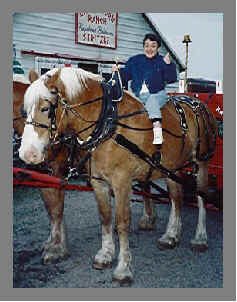 myself further toward Tad’s shoulders, and sit up. Triumph! I did it!
I did it, that is, with a considerable boost up. There were witnesses to the fact that I didn’t do it all by myself. But that doesn’t diminish the accomplishment. It just spreads the satisfaction around to more people. WE did it.
That’s not the first boost up I’ve had. A mere fraction of the list would include: My brother who carried me up and down the steps in grade-school until I could manage them alone. Friends who carried my cornet to and from the bus so I could practice at home. My parents who never told me I couldn’t do what I had an idea to do. Doctors whose surgical skill coaxed an amazing amount of mobility out of this crippled body. During those marvelous years among the Kimyal people in Irian Jaya, Indonesia, there were the Kimyal friends who carried me for hours in a special litter over narrow mountain trails. Now there are friends who help me in numerous ways, from doing massage to shopping to pulling weeds to … anything.
As wonderful as family and friends are, though, my experience is that all of us together still aren’t enough to get me on top of the PPS mountain. We need my supreme booster-upper, God. He’s always available to do it. And smiles with us at the triumph.
Our Offer:
If you want to receive PEN & ink by normal mail, send a request with your mailing address to:
P.E.N. S. 508 Shoreline Drive
Liberty Lake, WA 99019
We would appreciate a donation for printing and mailing costs, but if you are not able to do that it doesn’t matter. If you want to a subscription, let us know.
Polio Outreach of Spokane Library
Your resource for information on post-polio syndrome and disability issues.

Remember, you are not alone in your struggle. The problems that you or your loved one are experiencing now have been dealt with by others in the past. Their experiences are documented in some great material, all available in our library. Contact Darlene and tell her what your needs are. She can send you the appropriate material or tell you where to find it on the Web.
SOME TIPS are more useful than others….
OLD telephone directories make ideal personal address books. Simply cross out the names and address of people you don’t know.
A TEASPOON placed in a glass on the back seat of your car makes a handy audible gauge for road bump severity.
FOOL other drivers into thinking you have an expensive car phone by holding an old TV or video remote control up to your ear and occasionally swerving across the road and mounting the curb.
DRILL a one inch diameter hole in your refrigerator door. This will allow you to check that the light goes off when the door is closed.
SAVE electricity by turning off all the lights in your house and walking around wearing a miner’s hat.
AVOID parking tickets by leaving your windshield wipers turned to ‘fast wipe’ whenever you leave your car parked illegally.
TAKE your garbage can to the supermarket with you so that you can see which items you have recently run out of.
SAVE on charity donations by spending a $10 on clothes at a charity shop, then selling them for $5 to another charity shop. This way you can give twice as much, at half the cost. I think. chuckle