
“What are the risks?”

| Current CDC Recommendation – the new immunization schedule | Website Links (“a wealth of information”) | OPV or IPV – which should be used? | Polio from a vaccinated sibling? | Polio from her vaccinated baby – Jan., 1996! |
 Polio–with its power to paralyze and kill–was among the most dreaded contagious diseases. Children were its most vulnerable victims.
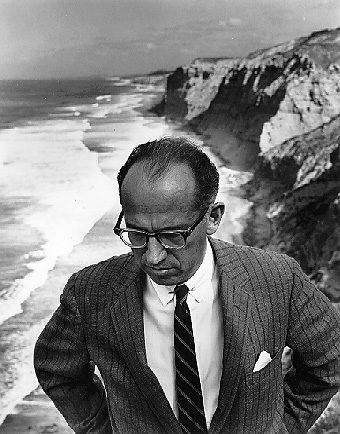
Jonas Salk, founder of the University of Pittsburgh’s Research Laboratory, was among those leading the assault on polio. In 1954 Salk and his Pittsburgh associates began the human testing of the first truly effective antipolio vaccine. Within another few years, outbreaks were fast becoming a thing of the past.
Photographer Philippe Halsman took this picture of Salk as he inspected the site in San Diego, California, for the Salk Institute for Biological Studies.
Courtesy of the National Portrait Gallery, gift of George R. Rinhart.
Photograph of Jonas Salk (1914-95), 1963, by Philippe Halsman (1906-1979), gelatin silver print
The sands of time have not washed away polio’s threat…
Current Policy 
Starting in January 1997, it was recommended that children should get their polio vaccines in a combination of shots and sugar cubes. The policy, approved by the Centers for Disease Control and Prevention, is the first major change since 1961 in the way the vaccine has been administered. It says infants should be injected with a vaccine made from killed polio virus twice within their first four months, followed by two oral doses of weakened, live virus between ages 1 and 6. Most children now get three doses of oral vaccine by age 2.
DEPARTMENT OF HEALTH AND HUMAN SERVICES
Centers for Disease Control and Prevention
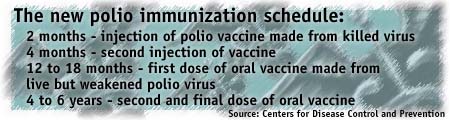
(From Webmaster: An explanation by the National Immunization Program as part of the IPV/OPV implementation plan can be seen at CDC’s POLIO VACCINES Web page.)
Website Links
“The Vaccine Associated Polio Society (VAPS)  is a non-profit organization dedicated to ensuring continued medical care and sound public policy for people living with Vaccine Associated Paralytic Polio (VAPP) through education, advocacy, and research. … VAPS is dedicated to solving the medical and reimbursement issues faced by people with VAPP. …” WELL worth checking out!
The Polio Plus program of Rotary International – In 1985, Rotary International launched this 20-year commitment to eradicate polio worldwide, one of the most ambitious humanitarian undertakings ever made by a private entity. This page contains a wealth of information about the global polio eradication effort. Recommended!
OPV or IPV — which should be used? 
A professor’s letter to the Center of Disease Control, relative to proposed new guidelines:
June 1, 1996
Gloria A. Kovach Committee Management Specialist CDC (16-4346) 1600 Clifton Road NE Mailstop D 50 Atlanta, GA. 30333 Dear Ms. Kovach: In the years spanning 1955-1961, when the first Salk vaccine was administered to children in the United States, the incidence of Polio decreased ten fold. The case rate during the epidemics of the early 1950’s was about 10 cases per 100,000 of population. By 1961 the incidence was less than 1 case per 100,000 (1). At the end of that period, in 1961, the Sabin Oral Polio Vaccine came into routine use. The use of this new live attenuated vaccine was justified at that time because of the large number of cases that were occurring within our population, the possiblility of an outbreak of increasing numbers of cases, and the rapidity with which the OPV could be administered. In 1978, a killed injectable vaccine, more highly purified and concentrated than the 1955 Salk Vaccine, became available. The older live Sabin Vaccine, it is argued, produces better local immunity in the throat and intestines, is less expensive, and does not require an injection. However, estimates, which I believe are low as physicians can fail to admit complications to their vaccinations, are that vaccine related paralytic poliomyelitis occurs in one case out of 520,000 first doses (2). Both the OPV and the ISV provide durable active immunity (3). Based on current evidence it is safer to use killed (ISV) for a child’s first vaccine doses. And, if Sabin is used for later doses, household members should be vaccinated with the killed ISV first. We have had great success in reducing the incidence of new polio. Since 1991 we have not had a case of wild polio in the United States. Yet we continue to see vaccine related cases of paralytic poliomyelitis, estimated at 10 or so per year. Is the death or injury of an infant or parent an acceptable side effect for the prevention of disease in a population that is having no incidence of that disease? The CDC continues to recommend OPV for routine inoculation, with IPV as an acceptable alternative (4). I submit we should rethink this recommendation. We have it within our power to accommplish ZERO cases of polio in the United States in each of the coming years. The Immunization agenda should not be set by the powerful, but by a rational goal oriented policy. I believe that recommending the use of the Improved Salk killed vaccine in place of the live vaccine will achieve a zero case goal. 1. Morbidity and Mortality Weekly Report, 41 (55):46, September 1993, Centers for Disease Control and Prevention 2. Microbiology, A Human Perspective, Eugene W. Nester, C. Evans Roberts, Martha T. Nester, Wm. C. Brown, 1995 3. Microbiology in Patient Care, Josephine A. Morello, Helen Eckel Mizer, Marion E. Wilson, Paul A. Granto, Wm C. Brown 1994 4. Morbidity and Mortality Weekly Report, January, 1995 Edward Bollenbach Professor of Biology Northwestern Connecticut Community-Technical College
Winsted CT. 06098
Polio from a vaccinated sibling – can it happen? Yes:
One person’s story:
I had polio in 1965 in Broward County, Florida. According to correspondence between the CDC and the Florida State Board of Health there was some question as to whether or not it was “vaccine-related”. Here is an exerpt from the final report on my case addressed to Dr. Charlton Prather M.D., Director of Division of Epidemiology for Florida State Board of Health from Dr. George Miller M.D., Chief, CNS Disease Unit: “Thank you…final report on Sharon Wilson, a 1965 poliomyelitis case. She is indeed a very interesting case particularly in light of her previous vaccination with both Salk vaccine and two types of oral polio vaccine. I am afraid that we cannot state with any surety in any single case whether the disease was indeed “vaccine-associated”. However, you will find in the 1965 final summary of poliomyelitis, which should be coming out shortly, a line-listing of 8 cases with a history similar to Sharon Wilson. All these 8 individuals developed paralytic polio within 60 days after contact with a household member or playmate who had received oral polio vaccine.” My younger sister and brother had recently received the oral polio vaccine within 30 days of my initial illness. I also have a lab result report from the CDC that indicates that the polio 3 strain they isolated from stool and throat cultures most resembled that of “vaccine virus” than “wild virus”. I won’t quote the whole interpretation but it appears that they don’t want to admit to it being vaccine related as the final words were “it is not possible to state definitely it is a vaccine derived virus.” I don’t know if this is the kind of story you are looking for as my case appears to be indirectly related to the vaccine (via a sibling) and was never officially concluded to be vaccine related (did they ever admit it?). I have many of my records and would be glad to help in any way that I am able. ——- Sharon Heymheym@ix.netcom.com
Polio from her vaccinated baby – an unnecessary risk:
This mom is newly Recovering from acute polio:
20 May 1996 I recently got sick with paralytic polio this Jan. 1, 1996. (What a welcome to the new year, ha???) My doctor said I got it from MY BABY’S LIVE POLIO VACCINE. She got it last Oct. 95. In was in her system for about three months. Unfortunately, I did not know about the risk – wasn’t told about it. Thank God, there’s nothing wrong with her. I was told I probably got it while cleaning her poop. My whole body got affected – swallowing, eyes, arms & legs. I’ve been home since Feb 29. Was in ICU & then Rehab for 6 weeks. Now I get therapy at home. How am I doing? I can now swallow my saliva. I’ve also started eating soft food – soup, ice cream, jello, lots of juices & nectar. But still get tube feeding. My eyes still don’t blink tho. My arms are getting stronger, esp. the right – which was the stronger of the two when I got sick. My legs too are getting stronger – I’ve started climbing stairs – 5 steps only, so far. We have 16 total. Yesterday. I was also able to walk from the handicapped parking space to inside our church & back – no wheelchair!!!!! Was also able to use my hands & arms to operate the electric wheelchair at the grocery to help my husband do the weekly shopping. Great milestones for me after being so weak for the past 5 months. I still believe in miracles – & look forward to more recovery. What frustrates me the most??? Not being able to carry & care for my 13 month old Samantha. My Mom, who’s temporarily with me to take care of our baby, says we walk the same way – & she even walks faster & has more strength!!! My husband has been the greatest through all these – he’s my best nurse!!! I get fitted for orthotic for my weaker right leg this friday. My PT hopes this will improve my gait & help me climb stairs better. Everyone’s story is helping prepare for a change in lifestyle. I’m considering fatigue a lot in my therapies – pray not to get PPS in the future. Used to be a very active person before I got sick last Jan. (’96)- step aerobics & weights everyday. I miss this a lot & driving too. Chatie
Any comments? Click on the message boy: 
To: P.E.N. main page
Copyright © Polio Experience Network, 1997-2004. All rights reserved.
For some graphics sources, see P.E.N. home page.
Revised: August 15, 2004.