
|
|
||
|
|

When Your Home Is Not A Safe Haven
By Laura A. Ryan, OTR/L, Maria H. Cole, OTR/L, Dorothy D. Aiello, PT, Julie K. Silver, MD
Futures Unlimited Opens A Clinic in Spokane
By Alex Looms
More Than A Piggybank
By Elinor Young
In Remembrance of Robert Rubesh
WEB FINDS
P.O.S. Library
Our Offer (for a mailed subscription)
Copyright information
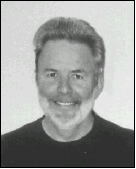 Futures Unlimited Opens A Clinic in Spokane
By Alex Looms
It would be hard to find a member of our Polio Outreach of Spokane support group that had not heard of Futures Unlimited. Many of our members have traveled to Columbus, Mississippi to undergo the treatment developed by Ed Snapp.
Although different from others, Ed uses treatment protocols that are common in conventional physical therapy. What makes his unique is the manner and sequence that they are applied.
I suffer from most of the classic PPS symptoms. Still I have been able to do most things that I needed to, as long as I was careful not to overdo.
Several years ago my local HMO they would not approve my physician’s request to send me to Futures. Their reply was, This clinic is out of our area. They are not an approved provider. My appealing their decision was flatly turned down. Our financial situation at the time made paying for it myself impossible. I relegated myself to the situation by saying, “Well, I’m still in pretty good shape. They probably couldn’t do much for me anyway.”
A few years passed. My physical situation deteriorated very slowly. I was still able to do a lot but the pain had increased, and the period of rest between tasks went from minutes and hours, to hours and days. The chronic pain made me pretty crabby, driving became a painful ordeal. I wasn’t the cheerful Alex that my friends and family had come to expect. Something had to be done!
It is interesting that often when we have a need, God provides. What we all need to do is be open when such an opportunity reveals itself. My opportunity came when Futures made the decision to open a facility in Spokane, WA. Gone was the need to spend a couple of thousand dollars for travel and the expenses needed to stay in Columbus. They say “Necessity is the Mother of invention.” As I mentioned earlier, I was having difficulty driving. I had just spent a year and a half restoring a rare and fairly valuable 1958 Volvo station wagon. I had made several fun trips with it, but being practical, I decided to sell it while it was still in pristine condition. I ended up with two collectors fighting over it and sold it for a substantial sum. It 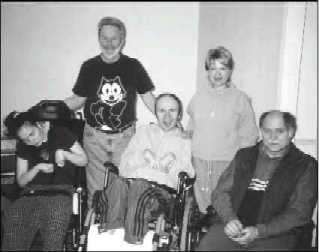 was enough money to pay off several nagging bills and also to go to Futures.
I had the good fortune to be one of the first five people to be treated at the new NW Futures. As with any new business there were a few loose ends. Washington’s regulations were different from Mississippi’s and the building needed some modifications. Ed’s son, Jamie Snapp, who runs the Spokane facility, quickly resolved the problems.
I was surprised at the young age of the staff. I have children their ages. But it became immediately apparent that they were dedicated and professional.
The treatment takes twelve consecutive days. They own you from 8 am until almost 5 pm every day. It is passive therapy. You just need to relax. The most difficult thing for me was to turn my brain off.
 I had opted to stay in a local motel rather than drive an hour each way from my home. I had no preconceived notions of what to expect from the treatment. Still, I was skeptical that they could do much with me. I had only hoped to relieve some of my pain.
It’s been two months since my treatment and I want to be realistic about my improvement. After all, twelve days of massage, hot tubs and rest, who wouldn’t feel better?
So what can I say for sure? I feel great.
People who know me say, “Wow, you look great!” The debilitating pain is gone. Yes, I still have pain but it is no longer constant. I have been able to reduce some of my medication. My spirits are better and so is my sleeping. My family has noticed changes that I was unaware of. My shaky hands, my facial expression, lots of little things. One highly unexpected result amazes me even now.
When I was 13 I started having a great deal of pain in my left foot. The bones had collapsed. I had a flat left arch and a normal right arch. Doctors, after trying several unsuccessful treatments said , “You’ll just have to live with it.” As a result my left side was 1/2″ shorter than the right. On the morning of the fifth day of treatment I was brushing my teeth, looking into the motel mirror and noticed my shoulders were level. I finished getting dressed and noticed not only my shoulders were level but my belt was too. Intrigued I looked at my feet. My left ankle bone was almost even with my right, my left foot had corrected itself!
Summing up…, was it worth it? Yes. Would I recommend it to others? Absolutely. Should everyone expect great gains? No, but I expect that everyone could benefit from going. Would I go back? You bet.
There is no doubt in my mind that going to the new NW Futures in Spokane has changed the quality of my life.
Alex Looms
More Than a Piggy Bank
By Elinor Young
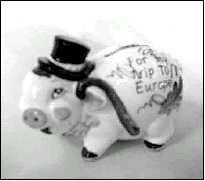 I don’t know that Grandma had anything profound in mind when she gave me the piggybank. I was plus or minus ten years old. It was just a cute gift for her name-sake grandchild—and maybe a subconscious reminder of financial responsibility from this survivor of the Great Depression. On the other hand, maybe Grandma did have something deeper in mind. Boldly painted on the side of the piggy-bank is “For My Trip to Europe.” Did Grandma pay special attention to those words, or was she just attracted to the cute pig? A mere four inches long, realistically it couldn’t hold much money for such a trip.
Thinking about it, one could say that the words were either a cruel joke or dream-makers. When Grandma gave me the piggybank, polio had already damaged my body from ever again being able to walk normally, let alone traipse around the world. “For My Trip to Europe”? Not possible, many would have said. I doubt that Grandma had any idea that her cute little gift sparked a dream in me. A challenge. A secret I kept to myself, knowing how it would be seen by others—”impossible.”
Every summer when Grandma came to visit, she brought me and my siblings each a crisp two-dollar bill. Not two ones, but the more rare two-dollar bill. We five children of a farm couple were comfortable and happy, but spare cash was rare. Grandma’s two-dollar bills were a high event! Each summer I carefully folded mine and stuffed it through the slot on my piggybank’s back. Once in awhile I acquired a coin or two to put in, too. For my trip to Europe.
As big as that dream seemed to be, an even bigger one was growing in my heart. In that soft, sure way that only He has, God was beginning to form in me what some would term a “calling.” I began to feel more and more clearly that he wanted me to be a missionary some day. Could it be? By the time I was thirteen, I knew for sure that was God’s plan. A big dream for a young girl who wore braces and used crutches. But why stop with just a trip to Europe? Why just one “impossible” dream?
I did get my trip to Europe a few years after Grandma died. I was in college and no longer needed either braces or crutches. One year the college offered a January Term course of spending the month in Spain and Portugal. The cost was the exact amount of extra money I had from my scholarships and grants that year. A chunk of my spending money came from … you guessed it … my piggybank. Not wanting to break it, I turned it upside down, and with a knife blade, great care and patience, I managed to extract all those two-dollar bills and the few coins. Thanks for the money, Grandma. And for the dream. Thank you, Lord, for making a way for it to happen.
God also gave me His bigger dream for me. I spent seventeen wonderful years as a missionary in a remote, mountainous, primitive area of Irian Jaya (West Papua), Indonesia before post-polio syndrome brought me back to America.
So is that the end of the dreams? No. Grandma’s gift of the piggybank began to teach me what God has reinforced in my life over and over. My body has limitations– now even more than before. Not only am I back in braces and once again need crutches, but also I’m weaker than I was when I lived out those former dreams. But limitations and weakness are no barrier to God. In His hands they are just the dark backdrop that shows more brilliantly the light of what He can do. He has planted some new dreams in my heart. They seem to be a stretch, given my body. I look forward to seeing how God will pull these off!
In Remembrance of Robert Rubesh
This is a brief story of a Polio survivor, but first and foremost, it is a story of my brother, the person.
My dear brother Robert passed away at 6:00 pm on Thursday evening, March 7, 2002. He had developed a brain tumor which manifested itself very suddenly on August 1, 2001. He went to work that morning, just like any other day, but at mid-day he was struck with a seizure which rendered him unconscious. He was hospitalized that afternoon and never went back home. The brain tumor was removed, but its “roots” remained. Later, while in a skilled nursing facility, he received physical therapy and radiation treatments, but his body did not respond and his conditioned worsened, little by little. He was 56 years old.
Robert was a survivor of Polio, which crippled his right leg at a young age. Despite his disability, he was very independent and resourceful. In his early career he worked as a photographer for a small local newspaper. He became an avid amateur radio enthusiast, obtaining a ham radio station license. He later worked at several area electronics supply stores, and held other service-oriented jobs. In 1991 he became employed by the US Social Security Administration as a Tele-Services Representative, helping people with their Social Security benefits. In September of 2001 he was recognized by the Social Security Administration for ten years of continuous service, and received a 10-year pin and a certificate while in the skilled nursing facility. Robert was very proud of that accomplishment, and his family is very proud of him for the warmth, happiness and caring that he showed us and others in his life.
He was a lover of all animals. He never complained about anything, even through his last moments of consciousness. We’ll all miss him terribly, but we are happy that he is free from the constraints of his body and in a better place.
In loving memory of my brother, Robert Rubesh.
Tim Rubesh San Diego, California – March 2002
 WEB FINDS
This issue’s article, “When Your Home is Not a Safe Haven” can help you do what is necessary to live longer in your home. Here are some Websites which offer similar advice:
—–
To learn about coverage, costs and different types of long-term care insurance, see the Website of the National Center for Assisted Living or Health Insurance Association of America.
—–
Sometimes programs that are listed for “Senior Citizens” also apply for people with disabilities. For state and federal services see the National Council on Aging.
Similarly, for community services, agencies and housing options in your area, use the Eldercare Locator or the American Association of Homes and Services for the Aging.
________________
The next site has nothing to do with any of the above. It’s a great site for a trip down memory lane, or to help your children and grandchildren understand what it was like during the polio epidemics. See the Museum site of the International Rehabilitation Center For Polio. It is a fascinating place to browse. The IRCP also has some very good polio and PPS information.
Polio Outreach of Spokane Library

Your resource for information on post-polio syndrome and disability issues.
P.O.S. maintains a large library of information on post-polio syndrome and disability issues.
The material is available by contacting our librarian, Darlene Hansen by phone at (509) 238-4512 or by E-mail at darleneh@cet.com
Some material is also available on our web-site at www.polionet.org/library/
and back issues of “P.E.N. & ink” at www.polionet.org/pen&ink/
Our Offer:
If you want to receive PEN & ink by normal mail, send a request with your mailing address to:
P.E.N. S. 508 Shoreline Drive
Liberty Lake, WA 99019
We would appreciate a donation for printing and mailing costs, but if you are not able to do that it doesn’t matter. If you want to a subscription, let us know.
P.E.N. & ink,
On the Web and mailed world-wide to provide experience based advice and emotional support for Polio survivors, families and friends.
Mailing address. . . 508 Shoreline Dr., Liberty Lake, WA 99019 U.S.A.
Copyright © 2002, Polio Experience Network (P.E.N. & ink). Original materials by P.E.N. writers may be reprinted in other newsletters as long as proper credit is given. Please send a complimentary copy of the publication to Polio Experience Network, 508 Shoreline Dr., Liberty Lake, WA 99019 U.S.A.
Back to “P.E.N. & ink” index page.
| (For information about up-coming meetings of Polio Outreach of Spokane, see the POS Webpage.)
Feature Article: When Your Home is Not a Safe Haven By Laura A. Ryan, OTR/L, Maria H. Cole, OTR/L, Dorothy D. Aiello, PT, Julie K. Silver, MD We think of our homes as havens–places where we are safe and secure from the unpredictable, mercurial and sometimes downright hazardous “real world”. More often than not, however, this security is unfounded. In fact, most of us live in homes that are fraught with hidden dangers that could potentially cause us serious injury. Indeed, studies show that accidents are the 6th leading cause of death in persons over sixty-five years of age and that falls account for two thirds of these deaths. Moreover, at least 1/3 of falls that result in someone getting hurt occur in the home or in other familiar surroundings. The good news is that research also shows that modifications to make your home safer can dramatically decrease your risk of falling. HOW TO MAKE YOU SAFE In order to minimize the chances of falls and subsequent injuries you must first rule out any health issues that may contribute to your risk of falling. In the medical literature, these factors are often called intrinsic factors. Intrinsic factors are those things that affect how your body works. Examples of intrinsic factors include, but are not limited to, blood pressure abnormalities, poor vision and/or hearing, the effects of medication and overall weakness and/or inflexibility. In order to optimize your safety you should ideally have an annual physical examination by your doctor that includes an assessment of your vision, hearing, balance and strength. It is also important to have your doctor review your medications. Simple changes in medications, eyeglasses or even a little physical or occupational therapy to improve balance and strength can have an enormous impact on your personal safety both at home and in the community. HOW TO MAKE YOUR HOME SAFE The medical literature also focuses on extrinsic risk factors for falls. These are things that may affect your ability to move about safely, but don’t have anything to do with your personal health. For example, the presence of throw rugs or slippery bath mats, clutter in your home, poor lighting and the lack of grab bars in the bathroom are all considered extrinsic risk factors that contribute to people falling. Because these risk factors have to do with the environment, they are nearly always correctable. THE GAME PLAN Since most of us have difficulty viewing our homes objectively, it may be worthwhile to have a physical or occupational therapist come to your home and make specific recommendations about how to make your home safer. This is generally covered by medical insurance if your doctor recommends a “home visit”. However, regardless of whether a therapist is available to come to your home, there are some basic guidelines for home safety that you can use to improve access and safety in your home:
are notoriously dangerous areas in home. It is critical to keep entrances free of clutter and to eliminate doorway thresholds and scatter rugs as much as possible. Outdoor walkways and stairs should also be clear of clutter and need to be shoveled and sanded when inclement weather occurs. A railing on both sides of indoor and outdoor stairs greatly improves safety. Nonskid tape and colored tape on the edge of the stair (a good visual cue—especially if you have poor vision) are also helpful. If you have difficulty going up and down stairs, consider installing a stairlift indoors and a ramp outside. Ideally in the kitchen, a gas stove is safer than electric because you can see when it is off and it cools quickly after being turned off. However, an open gas flame can be a real hazard, too. It is important to avoid cooking when wearing clothes that are loose or may get in the way of your heat source. When cooking, keep commonly used items within easy reach. Items that you use daily (e.g., pots and dishes) can be placed on the counter. For those things that are stored in cabinets it is best to keep them at waist height and toward the front of the cabinet in order to avoid stooping and reaching. There are many commercially available compartment accessories that you can use on your counters or in your cabinets to both improve how the space is organized and how attractive it looks.
Shower chair recommendations will depend on how much you weigh and how you move about. The features of the chair (e.g. armrests, surface type) should be considered as well as width, depth and height of the chair. A hand-held shower offers more control over directing the flow of water and adjusting the water temperature. This also allows you to get into the tub without having to step directly into the stream of water thereby reducing your chances of slipping. To improve safety when exiting the shower, a nonskid bathmat cut to a narrow width can be utilized. Getting on and off the commode can be a real challenge, and it is important to do this as safely as possible. A raised toilet seat can make a dramatic difference. The ideal height is typically 17-19 inches from the floor, but may vary depending on your height. Raised toilet seats can be purchased in many retail stores and recently there have been some very nice options that may make this more aesthetically pleasing than those available in the past. These seats also offer a variety of options, including armrests, adjustable height and different seat surfaces. If you use a wheelchair, the height of the toilet seat should equal that of the wheelchair to allow for a level lateral transfer. Another option is to elevate the entire toilet from the floor. A plumber needs to install this, but it does not significantly change the toilet appearance. Bedrooms should be devoid of clutter and have adequate lighting, particularly for nighttime purposes. Light sensitive nightlights that automatically turn on can make getting up in the middle of the night much safer. Ideally you should sleep on the side of the bed closest to the bathroom or doorway. Living rooms often have many tripping hazards including small tables, magazine racks, stacks of newspapers, raised carpets, etc. It is important to make your living room clutter free and with adequate room to move about. Seating should include a firm, supportive chair (with arms is preferable). If the seat is too low, a carpenter can increase the height by adding wooden blocks under the chair legs; however, this must be done so that the chair is secure and the blocks don’t stick out potentially causing you to trip. If the seat is too soft, adding plywood under the cushion can make it firmer. A lumbar support cushion can be purchased in many retail stores and often will provide additional support and comfort. For machinery such as lights, radios and televisions, remote controls will help you to avoid getting up and down unnecessarily. Lamps should be easily accessible or when possible, activated by remote control switches or auditory cues.
WHAT TO DO IF YOU FALL Not every fall can be prevented. So, it is wise to have a plan in place that will work if you do happen to fall. Perhaps the most important safety consideration is emergency response. There are specific emergency response services—most of these have you wear a pendant or bracelet with a button that you can press to summon help if you fall. Home alarm companies also offer emergency response services that work by a similar system (e.g., pendant or bracelet with a button). If you have a home alarm system, you can often add this service. Another security measure is to carry a cordless phone during the day. If you can’t easily get up from the floor, either a physical or occupational therapist can teach you the best way for you to do this in the event that you do fall. Obviously this would be a preventative measure and the goal of learning a “floor transfer” would be so that if you ever fell, you would know the easiest and safest way to get up. The statistics on falling and sustaining a serious injury are sobering indeed. However, it is comforting to know that there are some simple things that we can do to make our homes much safer in order to protect our loved ones and ourselves. Copyright International Rehabilitation Center for Polio. Reprinted with permission from www.polioclinic.com/home_safety_accent_on_living.doc. Originally appeared in Accent on Living—Summer, 2001. |
||

 Stairs and entrances
 Bathrooms can also be high-risk areas because of the slippery surfaces and often small rooms. Many people fall when holding onto a towel bar or pushing on the sink in order to stand from the toilet. This obviously is not safe to do. Instead, professionally installed grab bars, particularly next to the toilet and in the bath or shower, will make negotiating your bathroom much easier and safer. Generally a short bar (12”) vertical on the wall as you enter the tub and, ideally, a right angle grab bar on the far wall is recommended. Another simple and inexpensive option is to use a tub rail that clamps to the side of the tub—these can usually be installed without professional assistance. Moreover, this rail can be repositioned and provides a grip for both entrance and exit to the tub.
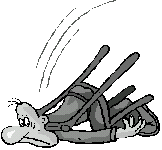 Minimizing clutter and ensuring ample space around the bed is also important. Comforters or blankets should be well fit so they are not dragging on the floor, as this is a tripping hazard.
 If you spend time using a computer, it is important to make sure you are safe and comfortable when doing so. The computer station components should be easily accessible and wires and cords should be removed from walking areas and tacked down. The chair you use should be a good height for you and you should be able to sit and stand safely.