
|
|
||
|
“Polio, the Scourge of the 20th Century” w Library Report w “Last Wishes” w Climbing Kilimanjaro w P.E.N & Ink Link w Web Finds w Eaves Droppings “Childhood Polio May Cause Chronic Fatigue Syndrome in Baby-Boomers” Copyright Information |
Sharman’s News G reetings from the Collins house! I hope you are joyfully anticipating the warm summer weather to come. I know I am looking forward to soaking up the sunshine. I’m so excited to report to you that Ed Snapp of Futures Unlimited, Inc., will be in Spokane on Monday, May 15, to discuss his treatment methods with any interested persons. Ed Snapp has developed effective treatment methods for post-polio syndrome as well as many other central nervous system disorders. Many of our members have been treated by Ed and have exhibited remarkable improvement. Ed will be at Shriners Hospital auditorium on Monday, May 15, at 6:30 p.m. Plan to arrive early–this will be a popular event and seating is limited. Our next support group meeting is on May 23. We will have a group discussion centered around various coping skills our members have developed in order to deal with post-polio syndrome. Be prepared to share your ideas with others! On June 27, Nancy Lee, Massage Therapist, will be our featured speaker. She will share with us the many benefits of regular massage therapy. Nancy is currently attending a five-year program at the Canadian College of Osteopathy and has completed her second year. Her study includes cranial-sacral therapy which is believed to have positive affects on central nervous system function. In June, Nancy is opening a new massage school in Spokane–Northwest School of Massage and Education Center. If you are interested in learning more about her school, contact her at 835-4000. On Tuesday, July 18, we have scheduled a tour of Shriners Hospital at 10:00 a.m. And after the tour, we will have a brown-bag picnic lunch at Manito Park. This will be our official “annual support-group picnic.” I hope you are all able to attend the tour and the picnic. Please let us know if you ride STA and need a ride to Manito Park and back to Shriners after the picnic. This will be an interesting and fun-filled event! We will not have a regular group meeting on July 25. At our August 22 meeting, we will have a movie night! Dim the lights and pass the popcorn! Bring your own beverage. We will watch a video that is of interest to those with post-polio syndrome. As you can see, we have great meetings planned. I am looking forward to seeing you at Shriners Hospital, W. 911 5th Avenue, at 6:00 p.m. for all these events. There is easy access from the free parking garage located under the hospital. If you are able to join us for dinner in the 4th floor cafeteria, please be there by 5:00 p.m. Much love from your friend, |
|




 Polio, the Scourge
of the Twentieth Century
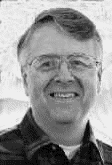
by Dave Graham
The world seems to be getting smaller every day, with high-speed travel and high-tech communication. And with that comes new understandings. One is that historically, the terrible polio virus, which once turned our own lives upside down, was also busy all over the world destroying and altering lives wherever it went.
Let me introduce you to my friend Rolf.
He and I are very much alike. We both had polio as youngsters. We have both had muscle transplant surgery on our left foot. Both of our fathers were in France in the military during World War Two. We have both led active contributing lives and now we are both grandpas. We have a great deal in common.
I have never met my friend Rolf face to face. Ours is a friendship brought on by the technology of the Internet and of e-mail communication. You see, Rolf lives in East Germany.
Rolf writes:
“…Like yours, my dad was a soldier in France during the war. At the end of 1945 he went as a prisoner to an American prisoner of war camp. He came home in late 1947. He never said bad things about the Americans. Other Germans, who were in the captivity of the Russians, told of terrible experiences.
“…The war was beginning in 1939 when I was seven years old. My father had to go into the army in 1940. Because he was a good locksmith he spent most of his time repairing army motor cars. He was never in a shooting battle.
“…I was born in Leipzig in 1932 and grew up in a little town named Delitzsch, which was 20 km from Leipzig. So we experienced the heavy bombardment. We heard and saw the Allied bombers, the explosions of the bombs, the fire and the smell. I was influenced by that tremendous damage that I saw, so I became a pacifist.
“…I had polio at age six in 1938. My treatings were done in an orthopedic clinic at the University of Leipzig. I remember there were only electrical currents and heat. It was very painful. While in isolation, they kept an iron lung ready for me, but it was not necessary to use that apparatus. When I came home to my parents there was a total paralysis of both of my legs and backside. By the time there started a gradual restoration of my strength, I could visit school with the help of my mother. School time was good for me for I always had very good fellows. I never felt disabled. I was sportive, learned to swim and made apparatus exercises.
“…The time after the war was very hard for all of us. Father was a prisoner so we did not hear from him for a long time. There were only small rations of food so I know what it means to be hungry. My mother and her sister would ride their bikes around the villages looking for harvested grounds so they could seek out leftover potatoes and corn. It was a very cold winter in 1946 and I remember not having enough wood or coal to heat our rooms.
“…We were delivered from the Nazis by American troops in 1945. A few months later came the Russians and with them all the trouble.
“…In Yalta, F.D. Roosevelt was too weak against Stalin. I believe he already had post-polio syndrome in some form. So maybe PPS played an important role in history. Sometimes I feel that all our living would have taken a totally different way if the Americans had not abandoned their part of Germany to the Soviets. Until 1989 we lived behind the iron curtain, cut off from the rest of the free world.”
I have had a number of very interesting e-mail communications with my friend Rolf. Today he is a highly educated Doctor of Biology and a family man. It is an honor for me to call him my friend. From his account perhaps we can begin to understand the scope of the damage that polio did and it’s profound effect on history.
Polio Outreach of Spokane Library
Your resource for information on post-polio syndrome and disability issues.

Library Report
by Darlene Hansen
Update yourself and your team! Our library now contains two copies of the new Handbook on the Late Effects of Poliomyelitis for Physicians and Survivors edited by Frederick M. Maynard, MD, and Joan L. Headley, polio survivor and Executive Director of GINI. Many polio survivors are experiencing problems that may not be appropriately diagnosed post-polio syndrome. Currently, it is generally accepted that post-polio syndrome “is a neurological disorder characterized by increased weakness and/or abnormal muscle fatigability in individuals who had paralytic polio many years earlier.” Additionally and very importantly, other causes for new muscle weakness and fatigability must be ruled out. The title most aptly describes the content and indicates it offers guidance and advice to all polio survivors. You may purchase a copy for yourself at International Polio Network by calling 314-534-0475 or electronically at gini_intl@msn.com. They may be purchased for $15.00 plus s&h of $3.50.
As your librarian, I am busy answering requests for information and materials. Often the request comes from an individual who has experienced more effects of the polio virus than I have and I am sent back to our vast accumulation of material for the answers. Sometimes, I cannot find written information on a particular issue and must refer them to someone else. Often it is difficult. How would you answer this question? “Does my need for a hip replacement have anything to do with my hip bracing?” Or how about, “Are muscle spasms common among PPSers?” Common inquiries include such topics as: the Social Security application process; the location of local support groups; and PPS knowledgeable physicians and treatments. Regularly I send out our Basic Information Packet, physician lists and info on Futures Unlimited Incorporated. I am pleased to be of service to you.
Last Wishes
By Paul Chamberlain
 “If I cannot give consent to my own death, then whose body is this?” thundered the dark-haired man standing only a few feet from me. The year was 1995, and Canadian Member of Parliament Svend Robinson and I were locked in debate before a packed auditorium at the University of British Columbia. The issue? Whether or not people who had lost the will to live should be given the right to end their lives with assistance from the medical community.
Robinson, an outspoken advocate for legalizing physician-assisted suicide (PAS), was quoting the late Sue Rodriguez, who had suffered from Amyotrophic Lateral Sclerosis, a disease which robs its victims of normal physical functions while leaving the mind intact. Months earlier, Rodriguez had gone public with a request to end her life with the help of a physician. Her wish was denied by the Supreme Court of Canada. And so, Robinson himself stood at her bedside as a lethal injection was administered illegally by an anonymous doctor.
His contention was simple: People who no longer want to endure suffering should be given the option of a gentle and peaceful death at the time of their choosing.
“No one has the right to deny them this service,” Robinson insisted. “Our refusal sometimes forces people to find their own, often violent, ways of ending their lives. The instruments of death range from loaded weapons to large doses of morphine to a reluctant friend with a plastic bag or pillow. We should act quickly to bring this practice out in the open where we can regulate it and make it more humane. All Sue Rodriguez wanted was to die with dignity and avoid the worst of what this dreaded disease still had in store for her.”
As my opponent continued his passionate presentation, my mind went back to another woman, one I knew and loved dearly.
When I was a child growing up on the campus of Prairie Bible Institute, my mother was strong and healthy, raising seven children. But at the age of 39 she was diagnosed with Multiple Sclerosis. By the age of 50 she was spending most of her time in a wheel-chair, and fifteen years later Mother was largely confined to bed, barely able to use her hands, speak, or even eat without choking. Food was taken through a tube inserted directly into her stomach and she lived with the help of a catheter and a host of medications organized and administered by my faithful father.
How difficult it was to see this once active woman lying on the couch, her body ravaged by disease, using what little strength remained to communicate to those she depended upon. Precious days of gardening in the sunshine, doing petit point, and roasting a chicken for Sunday dinner were over. Hugging grandchildren was a thing of the past; expressing her wishes and opinions virtually impossible. She had lost all control of her own life.
But had my mother also lost her dignity? Have Joni Eareckson, Christopher Reeves and Stephen Hawking lost their dignity simply because they have little control over their lives and bodies?
Many people equate the two, but I have come to believe that dignity has to do, not with how we control life, but how we respond to it. Whether we find ourselves in a wheelchair or on easy street, dignity comes in the way we meet life’s circumstances, not in the circumstances themselves.
As my mother’s health slowly deteriorated, I began to realize that she was becoming more and more like the people for whom euthanasia was considered a viable option. Beginning my studies at Prairie Bible College, I moved on toward a career in teaching ethics. As I moved further into the subject, I began to hear statements made about victims of debilitating diseases and the “poor quality” of their lives. The emphasis on “quality” of life versus its “sanctity” was turning public opinion more and more in favor of entertaining suicide requests from the ill and disabled. At the same time similar requests from the healthy who were severely depressed or facing intolerable life circumstances were denied.
Why were we willing to fight for some lives and not for others? Obviously these lives were being valued differently according to the quality we perceived them to have. The Scriptures and my conscience told me that this double standard was wrong. According to Genesis 1:26 all human life was made by God and stamped with His image, regardless of its condition.
I had never sought the public arena, but God had different plans. When the request came for the debate I began to sense that He was leading me to seriously consider the issues and develop my research on the subject. The very group of people who would be affected by the decision could not speak for themselves. I would do my best to give voice to their concerns.
I turned my attention back to the debate as my opponent sought to drive his point home: “Our laws allow suffering people the choice to die by refusing or withdrawing medical treatment. Why should we not also offer a lethal injection to those who want to die? Morally these actions are equivalent,” he added. “It makes no sense to allow one and refuse the other.”
As I began my rebuttal, I reminded the audience that a person’s wish to die does not justify our killing them in any other situation. In fact, the request, be it from a disabled person or a depressed teenager, is often in reality a cry for help and affirmation of worth. Our responsibility at that point is not to agree with their false self-diagnosis and confirm it by our actions, but to offer love and compassion and reaffirm their value in the eyes of God.
“Personal choice,” I said, “is really not the issue. The fact that certain people want a specific practice to be legalized is never sufficient reason in itself to proceed. People want to do many things. Some good, some bad. Every legal restriction is a restriction on someone’s choice. But we are justified in making them when those choices would have harmful effects upon others, as would be the case with assisted suicide.”
In my search for answers I had become acquainted with Dr. Peter Kyne, a Vancouver neuro-psychiatrist. “People who are dependent upon family and others,” he told me, “almost universally feel grief over the burden they have become. The sense of obligation to exit the situation, if that becomes a legal possibility, will be overwhelming and palliative care as an enterprise will fold its tents.”
The old, the dying, and the terminally ill are some of our most vulnerable citizens. Not only do they struggle with pain, discouragement, and a sense of uselessness, if PAS were legalized, people like my mother would face the added burden of having to justify their own continued existence.
Another danger is the risk of abuse. When we cease extraordinary measures that are futile or against a patient’s wishes, it is the underlying disease that kills; not the doctor. In assisted suicide, the doctor becomes the killer. This dramatic difference crosses an important line in the way we practice medicine, and the line between voluntary and involuntary is becoming increasingly blurred. In the Netherlands where physician-assisted suicide and active euthanasia have been openly practiced since the 1970s, an official government study discovered that approximately 1000 individuals annually are euthanized without their consent! Another 3600 have medical treatment withheld with the sole intention of terminating their lives, again, not at their request. The relationship between a doctor and a patient takes place behind closed doors. If assisted suicide became legal, the only one apart from the doctor who would know whether safeguards had been followed would be dead.
As the debate drew to a close I realized that the issue would continue to be raised among those who do not fully realize its ramifications and I thought of a quote by Andrew Coyne: “There are not half-lives or quarter-lives. There is only life. When we put the quality of life ahead of its reality, we let slip with it all hope of human decency…without the fixed compass of a reverence for life for its own sake, we are forced to take our bearings from a constantly shifting status quo.”
Had my mother ever wished for her suffering to end? I’m sure she did. What is it that gives her the ability to endure so faithfully with never a word of complaint? As my visit one day drew to a close, I asked how I might pray for her. “Pray, she said softly, her voice faltering, “that God will help me accept this.”
Despite losing all control over most of the functions that we would consider essential to “quality” of life, Mother has exhibited grace and dignity like few people I know. In the midst of deteriorating physical abilities, her spirit remained tender, her demeanor pleasant and cheerful. Never concerned for herself, she worried only about the hardships of those who cared for her.
I will always be grateful for the courageous example of my dear parents who faced adversity with  the help of God. I can do no less.
________________
Paul Chamberlain, PhD., has been professor of ethics at Trinity Western University (Langley, B.C.) for the past ten years.
*Article reprinted by permission of Servant magazine, a ministry of Prairie Bible Institute. Original copyrights of text and graphics reserved. Website: http://www.pbi.ab.ca/servant/spring2000/alumniinaction/
For more on this subject by this author, obtain his new book, Final Wishes.
A Book Review:
CLIMBING KILIMANJARO
An African Odyssey
By HELEN BERGAN
BioGuide Press, 150 p. 1999 $14.75
Reviewed by Liz Behrendt, Polio Outreach of Spokane
Don’t let the title mislead you – this is not a book about mountain climbing. Although the author walked on the lower slopes of the mountain, she did not climb Mt. Kilimanjaro. What she did instead was take a 3-month solo trip to nine African countries, which for a polio survivor using forearm crutches required an equivalent effort and adventuresome spirit as a long climb. Her view of a newly-independent Africa was as good as that from any mountain. As she states in her introduction “I don’t know for sure, but my guess is that I was the only blonde on crutches wandering alone and rather aimlessly around Africa in 1968”.
Helen Bergan worked for three years in Addis Ababa, Ethiopia as a librarian at Radio Voice of the Gospel , RVOG, a Lutheran World Federation sponsored short-wave radio station. When the time came near for her to return to the United States for a job with “a pension plan,” Helen decided to see some more of Africa before flying home.
During her three years there, she had traveled extensively around Ethiopia, driving a bright blue Volkswagen modified for her disability. She lived in the RVOG compound where there were staff from 11 countries and four continents. Among many interesting experiences were a plane delayed by a lion on the runway in Ethiopia, an all-day local bus ride in Kenya and being sick all alone in a hotel in Mombasa. In Jos, Nigeria, she spent a month caring for a friend’s house, which came complete with “house man,” night guard and a Siamese cat named Missy. She visited several game parks where she especially admired the giraffes, traveled on two freighters and gracefully parried advances from men intrigued by a young woman traveling alone.
For me the most fascinating aspect of the book is her openness to other cultures, her love of local markets where she conversed with many of the vendors in spite of knowing no African languages, and her delight in the various types of food she was offered and consumed with relish. Her descriptions are colorful and humorous, and show a warm and generous spirit towards friends made while working for RVOG as well many strangers she met along the way. My only regret is that she waited so long to publish this book, as Africa has undoubtedly changed a great deal in the last 32 years. Still, it is enjoyable to read, and I admired her adventurous spirit and resourcefulness in solving the many unexpected problems encountered along the way. Included in the book are instructions on “How to eat a Mango” as well a number of delectable-sounding African recipes adapted for American kitchens and conveniently indexed in the front. I tried the “Baked Bananas” and found them delicious. Perhaps I’ll bring some to our next potluck.
__________________________
This book is not readily available in most book stores. It may be ordered online at amazon.com or barnesandnoble.com, but ordering it directly from the publisher is faster. To do so, send a check for $14.95 plus $3 shipping to BioGuide Press, P.O. 42005, Arlington,VA 22204 or call (703) 820-9045 to order with a credit card.

Our friend Ron Haack shares a few hints.
If you are disabled, your local phone company has some suggestions and services. They may even offer you a reduced phone rate.
Callwave .com has a great service. If you are tying up your only phone by being on-line, their service will notify you of incoming calls.
For Loan
If you live within reasonable driving distance of Spokane and need something to help you in and out of the bathtub, we’ve got just the thing for you. A hydro bath seat which operates by being hooked to your shower connection, has been returned to Polio Outreach of Spokane for loan to the next person who needs it. It works great—easily lowers you into the tub, then lifts you back up again by using your normal household water pressure. If you are interested in borrowing this device, contact Elinor at 238-4812 or polionet@polionet.org.
Comments from readers
:
“I’m doing
a huge five page research paper about Polio. I thought all hope was lost until I came to your website. Your page has so many helpful tidbits that I could use (easily too!) Thanks for putting this website up. Thanks,” M. —– (In the interest of fairness, we should say that one person told us that page was NO help at all! Well, we didn’t say we’d write the papers for them )
“As I continue
to travel through the P.E.N. & ink site I am impressed with what I have seen. I will continue to come back and will add your site to my list of PPS links. Thanks,” G.
“Where can I
find out how to get Polio?” (Huh?)

 WEB FINDS
w
This time, the “find” is us! We recently received a request from the National Council for the Welfare of Disabled Persons (NCWDP), a policy-making and coordinating government agency of the Republic of the Philippines. This agency was given the task to “develop a broad public information and dissemination program on disability prevention, rehabilitation, full participation and equalization of opportunities. As part of this function, the Council publishes (quarterly) inspiring news articles from the web, distributed free of charge to different organizations servicing the needs of persons with disabilities.” They asked permission to reprint articles from the “Inspirational Items” page of our Website, saying that the articles “will surely spice up our readers.” We hope so! Have you checked out that page of our Website lately? It’s at polionet.org/inspiration/. All the items there are original material—written by our own members. We’re proud that it is considered internationally useful! The Website of the NCWDP of the Philippines can be found at www.ncwdp.gov.ph.
w This issue of P.E.N. & ink includes an article about polio and chronic fatigue syndrome. What about another condition, that has over-lapping symptoms with PPS—that is, Fibromyalgia? We know of one article, “Fibromyalgia Is Common in a Postpoliomyelitis Clinic.” If you find any others, please let us know! Our email address is polionet@polionet.org.
w
It’s swimwear time! Or perhaps you do hydrotherapy year-round but are bothered by a reaction to the latex in your swimsuits. Check out “Suits Me Latex-Free Swimwear,” at http://www.latexfreeswimwear.com/.
w
Speaking of pools and swimming, if you don’t have access to a warm-water pool in the winter, summer might be a good time to catch up on some pool exercise especially designed for people with post-polio. Take a look at “Warm Water Pool Exercise,” Compiled by Mary Clarke Atwood; Editorial assistance by V. Duboucheron. From “Pool Exercise – Principles and Guidelines for Polio Survivors” by Robbie B. Leonard, M.S., P.T. You’ll find it at www.skally.net/ppsc/aqua/l.
Overheard at Polio Outreach of Spokane…
At February’s support group meeting, I heard some oohings and aahings, so I stuck my head out of my hole to see Ron spinning a 360 with his new power chair. Steve Whitley along with Doug and Amy from Choice Medical showed some of their products. The Jazzy power chairs have Active-Trac suspension that give them the ability to climb a six inch curb or travel over uneven ground. The three sets of wheels and compact size make it possible to spin almost on spot. The chairs range from small to large, costing $5000 to $8500.
Also in the room was a Victory four-wheeled scooter with a built in headlight. It will go 5 MPH and can come apart for easy transport – the heaviest piece being 38 lbs.
Steve told us about a new item– a Back Packer– which is a scooter lift that can be mounted on a mini van. Cost is about $1500. There is a new folding ramp in 5 to 10 ft lengths that weighs about 40 lbs. Doug showed us his sport chair that is made of titanium and only weighs 12-15 lbs.
In March, Susan Lienhard, a clinical pharmacist, talked about controlling pain. She stated that pain can be controlled in three ways: with cognitive intervention or relaxation, with physical manipulations (i.e., heat, cold, physical therapy) or with medications. The medications most commonly used to treat post-polio pain are non-steroidal anti-inflammatory drugs (NSAIDS) and antidepressants. Musculoskeletal pain can be controlled best by using NSAIDS and neurological pain responds best to anti-depressants.
Childhood Polio Infection May Cause Chronic Fatigue Syndrome in Baby-Boomers
by Dr. Richard Bruno
A childhood poliovirus infection may cause chronic fatigue in baby-boomers concludes a paper published in the January, 11, 2000, issue of the American Journal of Physical Medicine and Rehabilitation “Paralytic Versus ‘Non-Paralytic’ Polio: A Distinction without a Difference,” by Dr. Richard L. Bruno, director of The Post-Polio Institute at New Jersey’s Englewood Hospital and Medical Center and chairperson of the International Post-Polio Task Force.
Bruno reviewed the personal laboratory notebooks, publications and private correspondence of Dr. Albert Sabin, developer of the oral polio vaccine, regarding a 1947, Cincinnati, Ohio outbreak of the “Summer Grippe,” a flu-like disease that affected more than 10,000 children. Because Summer Grippe was associated with a stiff neck– a hallmark symptom of polio– Sabin hospitalized and studied a dozen children. “Sabin concluded that Summer Grippe was caused by a mild form of the Type 2 poliovirus which caused a flu-like illness even though it did not cause paralysis,” said Dr. Bruno. However, when Sabin infected monkeys with poliovirus from the Summer Grippe children, spinal cord and brain stem neurons were killed just as they would have been by a paralytic poliovirus. “Both the Summer Grippe and paralytic polioviruses damage the brain stem,’ Dr. Bruno continued. ‘Sabin showed us that even a ‘mild’ poliovirus infection could cause neuron damage that, although not apparent in terms of causing polio-like symptoms, was very real.”
However, Dr.Bruno reports that another ‘mild’ poliovirus outbreak did cause symptoms. In the very next year, 1948, over 1,000 Icelanders became ill with a flu-like illness causing stiff neck, some muscle weakness, and fatigue. While many of those with “Iceland Disease” recovered, some who became ill in 1948 still have fatigue today. “Iceland Disease was also apparently caused by a relatively mild Type 2 poliovirus,” said Dr.Bruno, “but one that did more severe and therefore more apparent damage to the brain stem — damage that caused chronic fatigue.” Fifteen years of research at The Post-Polio Institute has found evidence of brain stem damage in polio survivors who have fatigue associated with Post-Polio Syndrome, including lesions on MRI of the brain, attention deficits on neuropsychologic testing, reduced levels of brain activating hormones, and brain wave slowing. “These abnormalities are evidence of damage to the brain stem neurons that activate the brain – the brain activating system that keeps the brain awake and focuses attention – and they are identical to abnormalities seen in patients with Chronic Fatigue Syndrome (CFS),” said Dr. Bruno. “We believe that brain activating system damage causes fatigue in both polio survivors and those with CFS.”
Between 1934 and 1954, the year the polio vaccine was developed, nine outbreaks of CFS occurred either at the same time as polio epidemics or affected the staff at polio hospitals. “In fact, the first CFS outbreak was in 1934, sickening the staff at the Los Angeles County polio hospital,” said Dr. Bruno. And, just as in Iceland, some who were became fatigued in L.A. in 1934 remained fatigued for decades. “The symptoms of polio and CFS were so similar,” said Dr. Bruno, “that 48% of the patients in the CFS outbreaks between 1934 and 1954 were thought initially to have had non-paralytic polio.”
“Sabin’s Summer Grippe, Iceland Disease and the long association between polio and CFS have important implications for those diagnosed with Post-Polio Syndrome and CFS today,” according to Bruno. Englewood Hospital and Medical Center’s The Post-Polio Institute treats many middle-aged adults with fatigue who had non-paralytic polio as children. “Albert Sabin showed us that even a mild poliovirus infection can damage the brain activating system setting the stage for fatigue to develop later in life,” said Dr. Bruno. The Post-Polio Institute’s experience is supported by the 1987 U.S. National Health Interview Survey which found that 21% of those who had had non-paralytic polio report fatigue in mid-life. “The one million North Americans who had non-paralytic polio must be assertive,” said Bruno, “telling their doctors that both paralytic and non-paralytic polio survivors develop late-onset fatigue.”
An epidemiological study by Dr. Leonard Jason, published in the October 11, 1999, issue of the Archives of Internal Medicine, found that half of the estimated 836,000 Americans with CFS are at least 40 years old. Jason concluded that baby-boomers may be at greater risk for CFS. “Potentially half of those diagnosed today with CFS may in fact have had Summer Grippe or undiagnosed non-paralytic polio as children in the years before the polio vaccine became available,” said Dr. Bruno. “They may also have brain activating system damage that causes chronic fatigue.”
“There is no question that neither the naturally-occurring poliovirus nor the Sabin oral polio vaccine causes CFS today,” said Dr. Bruno. “But the possibility of a non-paralytic poliovirus infection in childhood causing chronic fatigue in middle-aged baby-boomers is a reason for hope.” The Post-Polio Institute’s research has found that conserving energy, daytime rests breaks, stopping activities before fatigue starts, and a higher-protein diet significantly reduce symptoms of fatigue.
____________________________
Reprinted by permission of Englewood Hospital and Medical Center.
Downloaded 04/13/00 from http://www.englewoodhospital.com/Pages/fullstory.php3?id=17.
The cited articles by Dr. Bruno may be found at Harvest Center’s on-line post-polio library, http://members.aol.com/harvestctr/pps/lib2/l in the “PPS Fatigue” section.
Our Offer:
If you want to receive PEN & ink by normal mail, send a request with your mailing address to:
P.E.N. S. 508 Shoreline Drive
Liberty Lake, WA 99019
We would appreciate a donation for printing and mailing costs, but if you are not able to do that it doesn’t matter. If you want to a subscription, let us know.