Inspiration, news and knowledge from Polio Experience Network
No. 26: September/October, 1998
Life !
by Elinor Young
It was the most glorious service! Before he died, my friend Bill had asked that his memorial service be one of praise with lots of music. It was. Wow, was it wonderful! From the opening Jesus Loves Me,” sung by three great-grandchildren; to “Taps” by a single trumpet as this WWII bomber pilot’s wife, Bonnie, was given the carefully folded American flag; to more songs by family and friends; to “Reveille” on the trumpet at the very end, the service was a perfect reflection of Bill’s life. A life lived in praise to God.
I met Bill and Bonnie when I returned to the U.S. when, in 1991, post-polio syndrome made it impossible for me to stay in my adopted country. For seventeen years I had been a missionary in the remote interior highlands of Irian Jaya, Indonesia. I was located in a little valley called Korupun, accessible only by foot or by single-engine aircraft which landed on a little grass and gravel airstrip. I had come to love the Kimyal people of Korupun. They live in simple grass huts and grow sweet-potatoes for their daily food. They don’t have the technology of the Western world, but they have a zest for life I seldom see in my home culture. They are volatile, animated, fun. Their language is much richer than English, full of graphic word pictures. They taught me much. I still miss them terribly.
In my corner of the U.S. it is hard to find many people who can relate to the life I had, and understand the impact of losing it. But Bill and Bonnie could. They, too, had been missionaries in a remote, “primitive” area of the world. Their setting was very different from mine. They had been at the northern-most point of the north American continent at Barrow, Alaska. But they knew what I was talking about when I spoke of the joys and challenges of working in a face-to-face culture of day-to-day survival.
But most of all Bill and Bonnie understood the joy of loving God, which was the motivation behind our taking on the challenges of living and working where we had, and was the sustaining strength we drew on as we faced new challenges. For me, that meant learning to cope with the limitations of post-polio syndrome; for them it was learning to cope with the challenges of the “senior” years, then Bill’s cancer and now Bonnie’s grief at losing him.
We had another tie. Bill and Bonnie have a daughter my age who has PPS but whom they couldn’t see very often. Teena lives on a one-family island in the delta of the Colville river as it flows off the north slope of the Alaskan arctic mainland. My PPS helped Bill and Bonnie to understand Teena’s and know it is “cope-with-able.”
A few days ago, as all of this mulled around in my head, my mind flipped the Kimyal switch and brought up a picture that illustrates the whole package. Actually, it played back a whole incident that took place my last year among the Kimyals.
An important church function was about to take place at Duram, about a two-hour trek away on the next mountain to the west of Korupun. As usual, the Kimyals would carry me on my pole-and-sling-seat carrier. I called it my MTS (Mountain Transport System). Even at their best, my polio legs couldn’t carry me around those mountains. Two to eight men, depending on the difficulty of the trek, would put the poles on their shoulders and off we’d go. I had made the trip to Duram many times. No big deal. Except this time.
Anticipating that over 1000 people would be trekking over and back from Korupun, for weeks the Korupun church leaders had grumbled about the condition of the bridge over the Erok river between Korupun and Duram. The pole-and-vine suspension bridge had fallen into such disrepair that even the Kimyals considered it dangerous. But no one on either side seemed to want to take the responsibility for it’s rebuilding.
Knowing the state of the Erok bridge, I had written off any thought of attending the function at Duram. The Kimyals were very careful about where they carried me, always staying within the limits of what they were sure they could do safely. Well, safe in their eyes. I knew they would not ask me to go to Duram. I was wrong. A few days before the event, they pleaded with me to go. I reminded them about the bridge. They said, “Oh, we can go through the water.” I protested that the river was way to swift and deep to be crossed that way.
They assured me, “No, there is one place we can go across. We do it all the time. We can do it. It just makes the trail longer.”
“But if it’s too dangerous that day, you’ll bring me back, right?”
“Oh, it’s good. We’ll get there fast.”
“Well, all right. I’ll go…”
I hung on tight as my MTS dipped and swayed in rhythm with a trail that was either a mere scratch on the mountain-side, barely wide enough for two feet, or a plunge at nearly perpendicular angles down some wet cliff face. I loved the wild thrill of it and the beauty of those sheer mountains. In an hour we reached the Erok.
I had been carried through rivers before, but never one like this. In this area the Erok races over and around huge boulders. I could see my carriers’ neck muscles tense as they eased themselves carefully onto the wet boulders, every fiber of their bodies concentrating on staying erect as their toes gripped invisible handles. My ears seemed to shut down even the roar of the river as my eyes took over my senses, watching each trembling foot as it’s toes grasped the next boulder, then the next.
That I’m writing this tells you we made it and began the long climb up to Duram village. Once there, we joined the celebration, ending with a feast of pit-cooked pig and vegetables. Yums! Then it was time to join the hundreds on the trail back to Korupun.
When we got to the point on the trail where we should have gone down to the river instead of on to the bridge, my carriers didn’t go down.
“Friends! Where are we going?” My voice came out a little too high-pitched.
“People went over the bridge,” they said. “It’s OK.”
Protest was useless. They had decided and I was not in control. When we came to the bridge I saw that, like a wounded ship, it listed to one side. A couple with a child stopped before they stepped onto it. The man took the baby from its mother, and sent her over alone first. In a crouched position, hanging on with both hands, she slowly crept across. Her husband followed just as carefully, holding the baby tightly. Normally the Kimyals go over those bridges with the same ease as a stroll through a village. “OK” they called it? If others wouldn’t cross even two at a time, how did they think the bridge would hold two carriers, my MTS and me all at once?
We stepped onto the bridge 30 feet above the river. If the bridge broke or we slid off, we wouldn’t be in pain long. Here the mountains on either side of the river seem to squeeze the Erok out of their restrictive grasp, shooting it into increasingly wider river beds as it dashes to the lowlands. The cliffs on both sides throw down the huge boulders that help churn the Erok into a foam in its excitement to be free.
Somehow, inch by inch, we made it across. As soon as my carriers’ feet stepped onto the opposite bank, the cliffs bounced with shouts and claps. Looking up, as far as I could see on the trail on both sides of the bridge, all traffic had stopped as everyone watched and willed us safely across that bridge.
“Great,” I thought. “So it was as dangerous as I thought!” Then I reflected, “And if we hadn’t made it?….” I had long since learned to dismiss such useless questions. For instance, “What if I hadn’t had polio?” Well, for one thing, I would have missed the marvelous adventure my life is. No, I prefer to look at life ahead – life sparkling with promise. Life pictured by the Erok itself shooting out of the mountains.
Maybe that’s why thinking of Bill made me recall this episode. Another thing we had in common is this joy of lives lived with the kind of abandon and freedom that our love for and by God gives. Knowing that even as we laugh, cry, groan and sing in our headlong plunge through the narrow mountain channel of life on this earth, we’ll eventually shoot out with even greater, purer joy and liberation into the wider channels of real Life-eternally. WOW!
The following article from our Polio Outreach of Spokane Librarian is the first of a three-part series entitled …
Building Your Medical Team
by Darlene Hansen
Part 1
Evaluate Your Health or “How Did I Get Here From There?”
My story probably doesn’t sound new to most of you. I had paralytic polio as an infant but lived my life without (or so I thought) any lingering effects. Most of my life I thought of my polio story like that of any childhood disease – uncommon, perhaps, but not something that would affect my adult life. The last few years I have begun to experience loss of strength. I have pain in my extremities, some fatigue and loss of energy. Recorded in this series of articles is what I am learning as I seek answers to my new health problems. I trust you will learn something that will help as you travel your path to wellness, too.
Seeking answers through friends and our support group’s library, I’m learning to identify and accept many typical behaviors and limitations that many of us have lived with but denied. I did not know that polio had any late effects. But statistically, some say that as many as 85% of us who had polio will have to learn to live with post-polio syndrome.
So just where do we start? With being honest! Honest about what we’ve been through, honest about our condition now, and honestly seeing where the past and present meet physically, mentally, emothionally and spiritually. Each affects the others, so all must be considered.
I have come to believe that most of us have tried to accomplish physical feats that pushed our abilities to the limit. We were told years ago that one must push oneself; make things happen. We spent years trying to do what others thought was best for us. Their intentions may have been good, but often their information was faulty. Trying to please, we have lost our ability to adequately communicate just how we are doing. Learning to do so now takes time. We must look at issues we’ve either ignored or deliberately put aside. We don’t even know what normal is, because we’ve been busy trying to convince ourselves and others that we were ‘normal’, whatever that is.
We must face it. Though we did not ask for that dreaded virus, but we contracted it, nonetheless. Our body is no longer functioning as we would like. We have a disability. Webster says that means, “A want of competent natural or bodily power, strength, or ability. Weakness. Inability to perform because of illness, injury or malfunction.”
Easy for Webster to state, but it’s hard to wrap your own life around those words, isn’t it? But we must, so let’s begin.
Step #1 Compile your medical history
Have you kept a record of what you’ve been treated for, when, and by whom? Can you reconstruct a medical history of yourself? Perhaps for those early years parents or older siblings can help. Hopefully, you have already gathered old hospital records or the like. If not, now is the time. What you can assemble will be the basic outline of your history. Add to it both the good and the things you might want to forget. This information can be of major importance in deciding the type of treatment you need.
Include childhood diseases, broken bones, family diseases, allergies, and the like. Women, don’t forget to add pregnancies, births and other female issues. This record will give you and any future physicians a baseline to work from.
Originally I didn’t include my childhood inability – even fear- of swimming and other activities that called for much endurance. Had I, I would have seen a picture emerging, and wouldn’t have condemned myself so many years for being ‘chicken’ or fearful.
Take a new look at such things. Place all this information in chronological order, and don’t forget to keep a copy for yourself. Then proceed to:
Step #2 Evaluate your present physical, mental and emotional state.
How do you feel first thing in the morning? After breakfast? After lunch? Do you want (or need) a nap mid-morning? How about in the afternoon? Is there a time of the day when you start to get confused or forget too many things? Or do you just go to bed when things get too ‘foggy’?
Are there activities you can’t do now, but could six weeks ago? A year? More?
How about focusing on various parts of the body. Your breathing, swallowing, range of motion, heat/cold intolerance, unexplained pain. All these should be noted and rated. (We have an excellent handout in the POS library that helps one describe pain: location and duration. Check it out!) Does your condition get you depressed and then spiral downward until you can’t function?
All these issues need to be explored and recorded by you before you seek medical assistance. After all, how can they help us, if we can’t even describe how we are feeling? I believe that we sometimes expect our health professionals to read our minds, evaluate our physical condition and prescribe a treatment program when we haven’t examined ourselves thoroughly. That’s not fair, is it? Ask someone to help you if it seems too difficult. We are not always objective about ourselves, so don’t try to do this all alone. Ask for help. Who knows, perhaps you will be giving another permission to ask for help of another kind.
Completing these two steps in evaluating your health will prepare you to start getting the help you need. How to do that will be covered in future issues of “P.E.N. & ink.” Those articles will be:
· Research the Medical Resources Available to You, or “Eenie, Meenie, Minie, Mo…”
This will cover conventional and alternative medicine, types of physicians and what their specialties cover, and other related information.
· Take Personal Responsibility or “You Want Me To Do What?”
Summer`s the time for picnics! 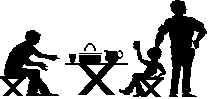 A report from Alex Looms
Our local support group picnic was held at Camp Caro on Saturday, July 25th. We had a great time. Our hats are off to Ron and Kay Haack for their efforts in organizing the food, etc. It was a lovely warm day, the kind of weather most of us feel best with. Music was provided by the Dave and Ron Band with Bev Pace and friend joining in. Steve Whitley from R&S Wheelchair brought down a couple of scooters for us to ding up , oops, I mean try out. The four wheeler that ran 8 mph was almost too fast. It did have a slower speed but I didn`t try that. Scooter races went well. No blood was spilled. Elinor was pretty much unbeatable. I think it had something to do with power to weight ratio. After good food, good company, good fun we all went our own ways. In all, another enjoyable outing.
Next on the PPS summer social calendar was the Polio Outreach of Washington, State Picnic, this year held in Ellensburg, to be closer to those of us on the Eastside. Ellensburg doesn`t seem very ‘East’ to me, but at least I didn`t have to add the additional mileage to go over the pass! There was a great turn out from all over the state. Close to 70 attended. I believe that it was the Everett group with the best attendence, at 23. Those attending from our Spokane group were Sylvia Smith, Joyce & Norm Park, Elinor Young and me, Alex Looms. Yes, it was a long tiring trip, but worth the effort to show our support for the state organization. Thanks to all those from the picnic committee (including Joyce and Norm from our group) who put in so much effort organizing, getting door prizes, etc . With any luck maybe we can get it even closer next year!
“We’re doing it!”
Thanks to your partnership, our unique policy of asking for donations rather than requiring a subscription fee is keeping this ship afloat. That is an encouraging indication that it is meeting your needs and interests. We don’t want anyone who is helped by P.E.N. & ink not to get it because they can’t afford it. January was the last time we mentioned the need for donations. It is time to do that again. We’re afloat, but not with a full tank. Let’s keep this thing going! Thank you.
Please send this form with your check to:
Polio Experience Network, 508 S. Shoreline Dr., Liberty Lake, WA 99019
Name _________________________Address ______________________________________
Amount donated: ________ Comments: ___________________________________________ ___________________________________________________________________________ ___________________________________________________________________________
Computer Connections
We have discovered an on-line magazine that is a great source of info for PPSers and others with neuromuscular problems. It is Paraplegia News, especially their on-line library at http://www.pn-magazine.com/PN/library/.
Check out the HUNTMASTER, “one of the most innovative products for sportsmen with mobility impairments, although the manufacturer says 95% of sales are to able-bodied individuals.”
A Paralyzing Fear: The Story of Polio In America. This film was shown at our August support group meeting. This is a must see for all polio survivors. It is very well done. It goes to air nationally on PBS on October 5 at 9:00 PM EST. Check your listing for local air time. A companion program will follow entitled, “Conquering Fear: Epidemic Disease Today” which will deal, in part, with post-polio syndrome. Dr. Lauro Halstead, an authority on PPS and Hugh Gallagher, who just wrote a book about this phase of the disease are highlighted in that segment of the program.
Don’t miss it!
Polio Outreach of Spokane Library
Your resource for information on post-polio syndrome and disability issues.