
“Na’e Yan Meeli, na’e Yan Meeli Gel.” It seemed everyone was going out of their way to greet me with this new name, looking so pleased when they used it. “Hello, Bad Legs. Hello, Bad Legs Woman.”
Polio at age five had left me with an abnormal gait.
“But what,” I pondered “is the real significance of my new name?”
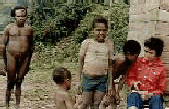 The Kimyals are a tribe of about 8000 people tucked in the high interior mountains of Irian Jaya, Indonesia (the Indonesian half of New Guinea). They live in tiny round huts in tightly packed villages. Theirs is a face-to-face culture with a face-to-face attitude. You always know exactly where you stand with them. Though short fused, cruel, and fierce at times, mostly they are friendly, animated, delightful people. They need little excuse to turn routine into an event of significance to relish.
Siud chose my “welcome back” feast to announce my new name. Having lived among the Kimyals for several years, I had recently returned from a break in the U.S. to spend several more years at Korupun.
One day I found my chance to ask Siud, “My legs are bad for sure, but what is the source-thought of naming me ‘Bad Legs’?”
“Your bad legs are important to us. In our villages people with bad legs can’t get out of this valley. But even with your bad legs God brought you all the way here to give us God’s Word. People with god legs have come and not stayed. Yet you Bad Legs, God has helped you stay with us. He did all this because He loves us.”
Bad Legs. What a great name!
All those people who had told me that becoming a missionary was an impossible goal didn’t understand. My bad legs aren’t a hindrance, they are a tool.
At Korupun, they were God’s tool demonstrating to the Kimyals how very, very much He loved them.
“Before I was born the Lord called me; from my birth he has made mention of my name. He made my mouth like a sharpened sword, in the shadow of his hand he hid me; he made me into a polished arrow and concealed me in his quiver. He said to me, ‘You are my servant, . . . in whom I will display my splendor” (Isaiah 49:1-3).
Though Post-Polio Syndrome finally forced me to leave my special people, my weak body remains a clever disguise:
God’s tool. His secret weapon.
 List of Elinor’s stories || Main page, “Our Own Stories”

Good Medicine 
 January, 1995
This Christmas brought to my mind some “good medicine” times of other Decembers, like my first Christmas in Irian Jaya, Indonesia. —————-
My psyche refuses to acknowledge that it is Christmas. The suffocatingly hot day has cooled somewhat at sunset, but the unmistakable odor on the wind is sweaty bodies, not snow. The sound assaulting my ears is not jingling bells but the swell of a language I don’t understand yet. The pageant begins and the angels dance onto the stage. Ahh, something familiar. Using Balinesian ballet movements. Nice. To the tune of “My Grandfather’s Clock.” Say what?
Two years later, my third Christmas in Irian Jaya, I am with missionary friends at Mapnduma, mountain home of the Nduga tribe. A small diesel generator lights two bare 40-watt bulbs hanging from the rafters of the shed-like church. The mountain night air is chilly, but the Ndugas are comfy, squatting on their hunkers skin-to-skin on the grass-covered dirt floor. The prevailing aroma is again sweaty bodies. The pageant begins. Gabriel comes in the back door and walks through the crowd towards Mary. He goes by too fast in the dim light. What is it that is different about him? (Besides the thick-soled dirty bare feet.) He is leaving, climbing out a window. Joseph takes Mary’s place at the front. Good. Gabriel will come back. Yes, here he comes. He is wearing a halo around his head and through the hole in his nose. Through what?! ————–
The laughter wasn’t good medicine until I laughed at myself, not at the “quaint” ways of people different from me. Why not “My Grandfather’s Clock” and who says angels have halos at all? The joke was on me, learning not to take myself or the (American) way to do it too seriously.
At Mapnduma we invented the MTS (Mountain Transport System) so that I could go on a picnic a couple of rivers away. Braced poles with an attached flattened net-bag for me to sit on and be carried, it was the Ndugas’ chance to learn that there is more than one way to scale a mountain. We laughed together.
Laughter — prince of barrier breakers and stress relievers. It helps me confront not being “normal” and invent a new way. It’s Vitamin L, the cope enabler. Keeps my spirit whole and my bones juiced. And it comes with a life-time, no-cost guarantee from its Maker. Beat that, all you herbals!
List of Elinor’s stories || Main page, “Our Own Stories”
Go-Karts and Such
May, 1995
I was reading a diary entry to a friend. That’s all. And I couldn’t finish. Suddenly I was crying. I didn’t mean to and certainly didn’t want to. I was reading it to Vickie just because I thought it was an interesting peek at a day that had been wiped from my memory. I hadn’t cried when I read it to myself. What happened?
The diary is one by brother found upstairs in Mom’s house, in my old bedroom. My diary. One I wrote when I was 13 years old. The entry says, “June 6, ’61. I’m trying to figure out what I want for (8th grade) graduation. I want a soap-box (car) or a Go-Kart, but they cost too much. Wish I had something to run around with like the kids do with their bikes.”
I cried when I began to read aloud the words of that last sentence. Words I would not allow myself to say when I wrote them. It would have been “complaining” or “feeling sorry for myself,” and I couldn’t allow that. I couldn’t allow anyone to know that I did feel different. And that it hurt.
It hurt deep, to the bones, to be left out of simple normal pleasures and games that my siblings and peers enjoyed. But I couldn’t say it. Much less cry about it. Not then. It might somehow weaken me. Weaken my ability to make people forget that I was different, and to prove that there wasn’t anything that I couldn’t set my sights on. No, I couldn’t risk a crack in the wall. I had to be unyielding to be able to make my way in a “normal” world.
So I couldn’t cry. Not then. I am now. Writing about it makes me cry. Is it OK to cry now? Yes. I need to cry those tears I couldn’t cry then. And I need to cry the tears of today’s losses, tears that are sometimes still trapped by the whispered, “No! Pretend! Be firm!” of that young girl.
I have learned something since I was thirteen.
Denial is weakness. Confession is strength.
Honesty is power.
Frank tears open the hurt and let the bad pain out. Not all the pain — just the bad stuff. The sticky stuff that keeps me mired. The resentment, the bitterness, the delusion. The pain that is left, the good pain, is that which empathy is made of.
Empathy is born of the good pain — those honest tears that grieve my loss, yet look beyond it to another’s grief. With our tears we connect: fit each other so we can help each other.
But wait a minute. Two drowning people can’t help each other unless one has hold of a life-ring. If you have read my columns before, you know that my life-ring is my relationship with God. He is my source of strength when mine runs out. He is the one with whom I cry the tears many don’t understand. He is the one upon whom I unload the bad pain and from who I craw comfort, the comfort that I can then pass on.
That’s why I can say that some of the pain is good. Incredibly, the word “praise” is even appropriate:
“Praise be to the God and Father of our Lord Jesus Christ, the Father of compassion and the God of all comfort, who comforts us in all our troubles, so that we can comfort those in any trouble with the comfort we ourselves have received from God.” (2 Cor. 1:3,4)
By the way, I didn’t get a go-kart and I never was able to ride a bike, but boy, you should see me now, free-wheeling my scooter down hills! You see, sometimes the comfort is a view of the eternal perspective and sometimes it is showing me other ways to have fun. Want to go scooter riding with me?
List of Elinor’s stories || Main page, “Our Own Stories”
Bruised Reeds
September, 1995
I just came in from grooming the pansies on my patio. One plant was yellow and dried up, but a two-inch piece was green and valiantly trying to root where it touched the ground. I stuck it in the ground, hoping it will grow and bloom.
While doing that, I recalled one nice Spring day when I was a young girl. I had walked to the farm next door and saw my aunt by her house. She was thinning snap-dragons, pulling up the small, crowded ones. The sun had already wilted some where they lay on the ground. I asked, “Aunt Martha, may I have those flowers?”
Despite her warning that they wouldn’t live, I carried the limp seedlings home and gently planted and watered each one. Eventually they burst into a happy display of blooms.
Somehow, recalling that story made me also think of Songmag.
Songmag, a Kimyal village girl living in the high mountain valley of Korupun, Irian Jaya, Indonesia, started doing house-work for me when she was 12. Neno, a boy of 15, did laundry and yard work.
Village leaders ended Songmag and Neno’s employment after a few years, when they stole some things. They were married, turned their lives over to God, and I could see some genuine changes of heart.
The next year, at age 15, Songmag had a baby boy. But something was wrong. She took her baby to Jessie, an Australian nurse who was my colleague. The little boy had no skull from above his ears and brow ridge; only skin covered his brain.
Kimyal babies are kept and carried in net-bags lined with leaves, grass and 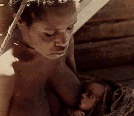 pandanas-leaf rain capes for wind-break and rigidity, so the bag doesn’t squeeze the baby too much. But that was scant protection for this baby. Jessie didn’t expect him to live more than ten days.
Songmag was heart-broken. Her love for her baby boy cut directly across Kimyal cultural values.
Defective, unwanted or twin babies were always thrown into a cold swift river. Songmag was taunted, “Throw the baby into the river. He’s no good.” She and Neno were told, “It’s your fault. It’s punishment for stealing. Throw him away.” Worse, Songmag was ostracized, the ultimate rudeness to be endured in Kimyal culture. Neno quietly loved and supported his young wife. Day after day I saw her on the trail without a companion and in her gardens with no one working beside her. Always her netbag was on her back, carrying her child. His unprotected brain often caused seizures, and Songmag would rush him to Jessie. Jessie could do little for the baby, but she did try to calm and console Songmag. Incredibly, the baby lived six weeks.
How did these two teenagers carry such a huge burden, withstanding that tremendous cultural pressure? They found their strength in the Lord.
When God asks, “May I have you, may I have your life?” even if we reply, “Yes, but you’re not getting much,” the Bible still promises, “A bruised reed he will not break, and a smoldering wick he will not snuff out. In faithfulness he will bring forth justice.” (Isa. 52:3) Those words reassure me when I feel our culture’s sometimes degrading attitudes towards people with disabilities. You know what I mean – those times when you wonder if you have letters across your forehead that spell “unworthy.” If your life is in God’s hands, He isn’t going to throw you in the river, or even leave you to wilt and die in the sun. People may, but “in faithfulness He will bring forth justice” in the end. I don’t know about you, but to me, that’s a tremendous comfort. ________
Before post-polio syndrome, Elinor Young spent eighteen years in a very remote part Indonesia, serving as a missionary-linguist.
List of Elinor’s stories || Main page, “Our Own Stories”
Reflections
November, 1995
The end of the year is often a time of reflection for me. As Thanksgiving and Christmas come, all of us tend to remember special holidays of the past. I’ve noticed, though, that since post-polio syndrome came to live with me, year’s end brings original polio memories to mind more frequently. Memories including my dad’s carrying me to the hospital in a snow storm. “Hurry, Daddy. I can’t breathe.” It was Jan. 6, 1952. I was barely five. Like it was yesterday – no, like it was today – I remember with tears the great sadness I felt when I first realized I could never wear the shiny red shoes I had asked for for my birthday. That was a big loss to a five-year old. Those red shoes still symbolize the polio losses.
This year my reflections started earlier. August 17th is Indonesia’s Independence day. That’s kind of ironic for me, because it was on that day that I left my profession as a missionary in Indonesia to come back to the States to find out what was wrong with my knees. I discovered it was far more than my knees, and I wouldn’t be able to return to my much-loved adopted culture and people. I was rapidly losing my hard-won independence.
Nevertheless, that day also symbolizes much that is happy. Many, many happy memories, including the trip back. It had been arranged that I would travel back with a family returning to Calgary, Alberta. There was no way I could travel alone. Typically (if you’re travelled in the “third world,” you know what I mean), when our plane came from Jakarta to pick us up in Irian Jaya, they had failed to reserve the right number of seats. Instead of six, there were only two. It was decided that I would get one and 18-year old Don would get the other. He was as experienced an international traveller as any of us, and strong enough to handle luggage for both of us.
My legs had gone, but my arms hadn’t lost their strength yet. No wheelchairs being available anywhere in that province, I used some home-made wooden crutches to which I tied a little red-and-white Indonesian flag. Friends carried me across the tarmac and up the steps of the plane, and Don and I were off.
Don called me “Aunt Elinor” and couldn’t have been more kind, considerate and helpful if I had been his mother. I had a letter from a doctor, requesting wheelchair support along the way, but it wasn’t until we hit L.A. that such was available. We landed in Spokane 35 hours after leaving Irian Jaya. My red-and-white Indonesian flag was still flying from my jungle crutches.
That was four years ago. For the encouragement of those of you who are new to this post-polio thing, let me tell you that you WILL learn how to cope with it all. It has only been in this past year that things have gotten better for me. It took me three years to get to this point. I don’t mean I have regained strength or have become free from other symptoms. But I have handled the major emotional hurdles and am intact and thriving. Most days.
You know the kind of hurdles I mean. The emotional trauma and depression of my body’s betrayal and of losing my independence and professional identity. The loss of contact with friends I left behind. The unique hurdle of cultural re-entry; I looked and talked like an American, but the resemblance ended there. Then there was the stress we all face of researching and pressing the medical community to get appropriate treatment and equipment.
Now I have a management program that is keeping the PPS controlled as much as possible, and I can think of my years in Irian Jaya, Indonesia, with a grateful smile. God gave me a very, very special gift in helping me to do what I did. Not many people get to even visit such a place, let alone live there, learn the language and make friends. Sometimes the tears of grief at the losses still come, but quickly behind comes the joy of the wonderful memories. Kind of like that red-and-white flag; the loss and the joy are side-by-side.
During the difficult first three years I kept telling myself, “Be patient with yourself. Give it time. You’ll learn. You’ll work out how to handle this.” I knew all along that the Lord was with me; that he would help and I would come out of the woods, but it would take awhile. I was right.
So, you who are newly facing the process, give it time. Use your tenacity to get the help you need. Use your head. Pay attention to what your body says is best. Have the courage to realistically face the truth about the needed changes, and make them. You’ll be OK.
List of Elinor’s stories || Main page, “Our Own Stories”
The Captain, the Servant
Febrary, 1996
I saw him on ABC news tonight. Captain John Testrake leaning out of the window of his TWA jet talking to reporters while a hijacker waved a gun out the window and around Capt. Testrake’s head. Pictures that mesmerized the world some years ago. Pictures of a man who died of cancer today, February 6, 1996. I didn’t see those pictures when the rest of the world did.
Hundreds of miles from a TV set I was at Korupun, a small valley tucked into the Snow Mountain range of Irian Jaya, Indonesia. The people at Korupun, the Kimyals, knew nothing of world politics. Their world revolved around raising their pigs, growing their sweet potatoes and gathering firewood and the materials needed to build their thatch-roofed huts. They had bows and arrows, not guns.
I followed the news of the hijacking by short-wave radio, listening to the Voice of America and the BBC World Service.
But when I saw Capt. Testrake on the TV screen tonight, it wasn’t the memories of the hijacking that those images invoked. My memories of him are much more personal of a few days five and a half years ago. The news story mentioned that after his retirement, John Testrake identified himself with a Christian flying service helping people all over the world. That was the John Testrake I remember.
My memories of John take place at Korupun. John Testrake and his wife Phyllis were in Irian Jaya as part of a tour they were doing for Mission Aviation Fellowship, seeing first hand MAF’s work so they could better describe it to MAF’s friends and supporters. MAF asked me if Testrakes could come to Korupun for a few days to see what a truely remote place was like, and experience what a life-line MAF was to us. I was delighted to have them come.
For  nearly a month I had been taking care of the 12-year old triplet daughters of friends, while the girls’ parents were in Java brushing up on their Indonesian. These were not doll and tea-party girls. Oh, no. Even taking them on two-hour hikes around the mountains didn’t use up all their energy. Testrakes came toward the end of the month; I was glad not only to see them, but also to have another diversion for the girls. My missionary colleague, a nurse, Jessie, was on vacation, so I was handling the girls on my own steam. Which was losing more and more of it’s heat by the day.
Karen, Kristine and Kelsie were delighted to help organize a pig feast for the Testrakes, and to take them around the valley, showing them the sights of the villages, rivers, waterfalls and mountain paths. I was glad they had someone else to go with!
In just a week the girls would leave for home on the north coast. Then I could rest. Why was I so tired? Sure, they were active girls, but I used to be able to handle that kind of activity and more. What was wrong with me?
Testrakes came on Wednesday, and were supposed to leave on Friday. But we were fogged in. Same on Saturday. MAF only does emergency flights on Sundays, so they would have to wait until Monday for their flight out – and hope weather allowed it.
Actually, it was the Lord, not the weather, which kept them there. After all of our hikes on the mountains, when I would silently pray that none of the girls would fall down a cliff and break something, it happened in my yard. At dusk Saturday, Karen was doing cart-wheels on the grass, landed wrong, and broke a leg. I heard it pop. I immediately sent out a call for Sabbil, the clinic worker Jessie had just trained in the setting of bones, and sent a note up to Jessie’s house at the top of the airstrip, where Testrakes were staying. Could John please come down and help us with Karen? Sabbil, John and Semia, the local pastor, all arrived. Sabbil confirmed that Karen’s leg was broken. He told me he’d make a splint – would John help? Sabbil measured Karen’s leg, then the guys went off to make a box-like splint. Phyllis cooked supper. I couldn’t handle that now.
I got on the communications radio and contacted a missionary doctor. All I could do was try to keep Karen comfortable for the night and call MAF as soon as it got light in the morning. Karen would have to be flown to a mission hospital at Mulia, a couple hundred miles away. Dr. Buce and his wife Janet would be happy to keep Karen in their home after he cast her leg. Karen knew and liked Buce and Janet. Karen would be fine and well cared for. Kelsie, Kristine and I would follow our original plan to fly out to Sentani on Wednesday. But I felt responsible; the girls were in my care. I really ought to stay with Karen; all of us should fly to Mulia in the morning. But I was exhausted; I knew I could not stay up half the night getting myself and the girls packed and ready. I just couldn’t do it. Why not? Last year I could have handled it. What was wrong with me? Why was I being so irresponsible? Why couldn’t I do it?
John Testrake was wonderful. I suppose next to the stress of the hijacking, this was small peanuts. But this time he wasn’t captain, and didn’t try to be. Sabbil, a simple village man who didn’t even have a grade-school education was in charge, and John followed his instructions. With respect. They brought the finished splint in, and John and Semia held Karen while Sabbil pulled her leg to line the bone up and bind it into the splint. John, the airline captain, a man who had seen the world and whose courage had been supremely tested, was impressed. He treated Sabbil like the equal he was in his world.
Karen was in great pain through the night. Kristine, Kelsie and I didn’t get much sleep, either.
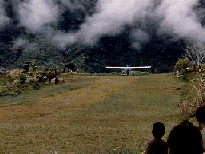 In the morning I called MAF and told them of our emergency. The fog was gone, the sun was shining and there was no wind. Perfect for the plane to come in. An MAF pilot’s wife who is a nurse came along to take care of Karen during the 2-hour flight. Her sisters cried. We waved goodby and fell silent as the plane lifted off our little grass and gravel airstrip.
Later that day Dr. Buce told me Sabbil had done a perfect job. The x-ray showed the bone was lined up perfectly. He didn’t have to set it further, just cast it. It was so good to have the Testrakes there to share my relief, and to comfort me.
But the guilty questions still echoed in my head. Over and over every day and even on the flight to Sentani on Wednesday. “Why couldn’t I have gone with Karen? What was wrong with me?”
A year later I was the one with legs in great pain. I couldn’t walk without crutches now, and was being flown back to the States for medical evaluation. A year after that I was well practiced in a scooter and was using a free-swinging arm support to hold my arm to brush my teeth and put on my make-up.
Now I knew what had been wrong with me. I had post-polio syndrome, and was weakening
fast.
The memory tonight’s news piece brought to my mind is not of a hijacking, but of a couple the Lord sent along to help me in a situation I did not have the strength to handle alone, and didn’t know why. Part of it is melancholy, but part makes me smile – the part about how God knew and provided. And still does.
List of Elinor’s stories || Main page, “Our Own Stories”
Things I Have Learned
May, 1996
It has been five years since my post-polio super-crash, when my legs suddenly turned into burning fire sticks and my whole nervous system felt like it was going to explode. Four and a half years ago I returned from Irian Jaya, Indonesia, where I had been a missionary, and began facing the issues of my new disability in earnest. As a Christian, for me facing an issue always means dealing with spiritual matters first.
These are some things I have learned:
-
I may ask, but must never insist on healing. To insist implies that I, not God, have the correct perspective on what this is all about.
-
Although I may ask for reasons this has happened, giving God all my reasons it shouldn’t, questions His justice. Though I don’t know them, I will trust God’s plans: “For I know the plans I have for you,” declares the LORD, “plans to prosper you and not to harm you, plans to give you hope and a future.” (Jeremiah 29:11)
-
Accepting and fully expressing grief is essential. Loss is sad. Even Jesus cried in sadness — but never in self pity. I must resist that.
-
I pray for joy while remembering that joy does not necessarily mean freedom from burdens.
-
When in a pit of depression, the only way up is out. I need to reach out to help a fellow struggler, whatever their problem. When I reach out, I am lifted up.
-
I must always pray for insight into creative (or obvious) ways to use the pain and weakness for good. “Don’t waste the pain.”
-
Inner peace comes when I accept and share God’s comfort, “who comforts us in all our troubles, so that we can comfort those in any trouble with the comfort we ourselves have received from God.” (2 Cor. 1:3-4)
List of Elinor’s stories || Main page, “Our Own Stories”
…And the Bauzis Laughed
September, 1996
I’m going to do it. I’m going to tell you a story I have only told two people before now. It is, after all, a rather painful memory.
If you, like me, had polio as a child and were left with visible effects, you probably know the hurt of ridicule. Strangely, despite my braces, crutches and a “galumph” to my gait, I wasn’t ridiculed growing up. A friend who was a few grades ahead of me in our small rural school said there was an unwritten rule among the kids that if anyone dared tease me, he/she would have been flattened on the spot. My community and my family protected me.
Maybe that’s why the incident recalled by this memory was so shocking. It is still so vivid I can recall the scent of the scene.
I am in Irian Jaya, Indonesia, where I lived for 18 years in a small interior mountain valley called Korupun, working as a missionary among the Kimyal. I love these small, animated people. Kimyals and I match just fine – I am 4 feet 7 1/2 inches tall, and they, as border-line pygmies, average about my height. Each of the 300 tribes of Irian Jaya have a unique stature, physique and personality.
The island’s geography displays similar variety. It is largely flat, swampy jungle sharply intersected length-wise by a spine of glacier-containing mountains. By flying, in half an hour you can go from steamy hot to freezing cold. Korupun, at 5600 feet elevation, is a favorite cooling-off vacation spot for missionaries located in the lowland jungles.
Reversing the normal trend, I am visiting missionary friends in the northern swamp-lands, taking a vacation, enjoying the heat and sounds of the low-elevation jungle. I am now in Bauzi territory.
Say the name and you’ll get a good idea of this tribe’s characteristic mien. Say an “m” before you explode the “b” and growl “ow-zee.” “Mb-OW-zee”. The men are big bruisers. I mean BIG! Being fresh from Korupun, to me Bauzi men look like 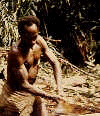 giants. They are 6 feet and more in height. From the time they could walk they’ve spent much of their lives standing in narrow dug-out canoes poling or rowing up or down rivers. Their thighs are like tree trunks and their upper arms and chests are like giant oaks. I’m not afraid of them, though. I have met people from several tribes, and haven’t yet felt antagonism from any of them.
One day, there at my friend’s place in Bauzi territory, I feel the need for some exercise so decide to go for a late afternoon walk. The jungle is alive with the sounds of birds and cicadas announcing, “Prepare! In an hour the sun will go down.”
The stale quiet heat is suddenly roused by five Bauzi men who appear out of the jungle on a path parallel to mine and about 25 feet away. Their bodies shine with several days’ sweat. They wear bark loin cloths or tattered, rotting ghosts of Western shorts and briefs. A pungent odor radiates towards me.
“Selamat,” (“Hello”) I say in Indonesian, thinking they probably know that much of the national language. They respond with a burst of laughter. They point at me, slap their legs, and rock at the waist in loud amusement. I don’t know their language, but I know what they are saying. As I continue walking, these big Bauzis mirror my gait; exagerating it. The jungle no longer feels friendly.
My mind races. “Their mood can swing in a snap. If they start to throw things, I have no defense.”
I try to win them by smiling and waving, but that only intensifies the amusement of the five men. Their howling laughter slams into my chest, weighing me down. Since contracting polio I have not been able to run, but my legs feel even more useless as I lumber as fast as I can towards the safety of my friends’ house, watching carefully that I don’t trip.
Then, without warning, the Bauzi men turn and disappear again into the jungle.
I’m almost to the house, but I dare not go in yet. I can’t let my friends see me shaking like this. They will ask why, and I can’t bear to tell them. No one is supposed to notice my “differences.” I want people to forget. And I’d be ashamed to embarrass my friends with the knowledge that “their” people were so cruel.
When I regain my composure, I go in. “How was your walk?” Ellen asks.
“Fine.” I smile and walk towards my bedroom.
That little room is not the haven I want it to be. The sounds in my head won’t go away. The cruel laughter, the voice of fear, the whisper of shame. “Lord, please, please — I don’t know how to handle this.”
Maybe that is another reason why I didn’t want anyone to know about this. My she-can-handle-anything image would be tarnished. So why am I now telling you?
Because I don’t mind admitting anymore that I can’t handle these kinds of things, I don’t have to. I have discovered what the much-maligned Biblical prophet Jeremiah found when he complained, “I became the laughingstock of all my people; they mock me in song all day long.” (Lamantations 3:14) But then he said, “I well remember them, and my soul is downcast within me. Yet this I call to mind and therefore I have hope: Because of the Lord’s great love we are not consumed, for his compassions never fail. They are new every morning; great is your faithfulness. I say to myself, ‘The LORD is my portion; therefore I will wait for him.’” (Lam. 3:20-24)
Yes! My identity is not what the Bauzis saw and mocked that day. Nor is it “that cripple in the scooter” someone sees at the mall. It is the real me inside, seen, described and loved by God. I don’t find any shame or fear there. Not even any anger, because the Lord sees inside the Bauzis of this world and loves them, too, and wants to change and heal what makes them so cruel. So, I am content to wait and let Him handle it; I don’t have to. Whew, what freedom!!
Hey, world, do you want to hear a story? I met these Bauzis on a path one day, and…….
List of Elinor’s stories || Main page, “Our Own Stories”
To Japan On An Inner-tube
November, 1996
I don’t know about you, but there are times when I feel that things seem plainly out of control. Like the time I got caught in an ocean tide. But, before we get to that, let me tell you about me and swimming.
On land, gravity keeps my legs under me. In water, my legs float, which might be OK if they could kick. But even self-floating legs would be all right if my arms could pull my weight through water, which they can’t. I just don’t have the right combination of working muscles to be able to swim. I can hang onto an inner-tube, though, as tenaciously as a barnacle to the Santa Maria. That ability came in handy once during my missionary career in Indonesia.
I had flown from my home in the mountainous interior of Irian Jaya to have a short vacation on the north coast. While there, one especially hot day, some like-minded friends and I went to the beach to swim. I got into the Pacific on my trusty inner-tube. Boy, did it feel good! .
The waves were wonderful… until I noticed they were getting more boisterous and I was farther from the shore than I should be. I tried stroking. Sure – my arms vs. the Pacific?! Shore was getting farther and farther away as I headed for Japan. I wondered how long it would take me to get there. Then I noticed, about a mile off shore, a line of Indonesian fishing boats. The whole-family-lives-on-them-all-the-time kind. Not pictures of reassurance, but there was a chance one of them would notice me floating by and pull me into their boat. I could visualize my potential rescuers heading into shore with me-and-my-inner-tube, asking swimmers, “We found this out there. Does it belong to you?”
By the time my friends saw my plight, I was past the coral. Frank tried to swim out to rescue me, but he got caught in the current, rolled around and cut up quite badly on the coral. I’d have to take my chances with the fishing boats.
Then my direction changed. I was in some kind of huge whirlpool that was taking me towards shore again. But now the tide was lower, barely covering the coral. My destination had changed from Japan to the bottom of the coral reef, still clutching the remnants of a sure-to-be-tattered inner-tube. It was time to get serious.
As each wave surged me forward, I pushed up on the coral with my hands to skim the inner-tube over the top. First one, then another, then another…. I made it back across the coral and to shore with barely a scratch — not even on my trailing legs. Their talent for floating served them well that time. My relieved friends pulled me out of the water, and I sat sheepishly on the sand, feeling badly for poor Frank who was lying lacerated and exhausted on the beach.
Actually, that’s not the only time life seemed to be taking me to Japan on an inner-tube. And I expect I’ll again find myself in a situation that seems out of control, propelling me in a direction I don’t want to go. As before, friends may be helpless to come to the rescue.
God didn’t send a helicopter to pluck me out of the water, either. Instead, he gave me the presence of mind and creativity to use the power of the very waves that could have spelled my doom, to lift me up and over the coral away from harm. So it has been with all of life’s waves, because, as the Biblical Jacob told his son, “The eternal God is your (my) refuge, and underneath are the everlasting arms.” (Deuteronomy 33:27) Under God’s control, the waves are meant for good. “For I know the plans I have for you,” declares the LORD, “plans to prosper you and not to harm you, plans to give you hope and a future.” (Jeremiah 29:11) I need to keep my head and use the opportunities God has wrapped in the waves.
List of Elinor’s stories || Main page, “Our Own Stories”
Asabing‘s Legacy
March, 1997
Asabing has been in my thoughts a lot lately. I’m not sure why. Maybe it’s the days and days of gloomy weather we’ve had. Grey overcast sky, lots of fog and the moody blahs. This is how it was when Asabing died. Well, actually, he was murdered.
I guess it’s not surprising, then, that these cold, grey days would bring thoughts of Asabing. But more than just thinking of his death, I think of his life. He was a great guy.
Asabing was a Kimyal, one of the tribal people I lived and worked among as a missionary in the mountainous interior valley of Korupun, Irian Jaya, Indonesia. The Kimyals are a semi-pygmy group of people, averaging under 4’11” in height. But they were fierce and ruthless. The neighboring Yalis, though bigger and stronger, were afraid of them. At war, Kimyals were like little fire-ants.
That didn’t describe Asabing, though. Yes, he was small – at 4’6″, smaller than the average. But there wasn’t a drop of fierceness in his blood. He was the most gentle man I’ve ever met, except my dad. He reminded me of my dad in other ways, too. He loved growing things. Every Kimyal grows a garden for daily food, but few consider it pleasureable. It would correspond to grocery shopping in our culture – something done out of necessity. Asabing was my gardener, and took chest-swelling pride in “our” yard. Other Kimyals would point to a flower and ask, “Can you eat that? No? Then what do you do with it?” Learning that I just look it at, my questioner would walk off laughing to himself. Asabing, though, delighted in those flowers, and did not think them silliness at all. His eyes sparkled at the beauty he created in my (oops! “our”) yard. Asabing also had a very loyal, generous heart. He would risk anything for a friend. In fact, he did.
For three months our Korupun grass-and-gravel airstrip was shut down while we did some major work on it, removing a four-foot deep “bounder” at the touch-down area. Without machines, using just muscle power, the project was a major task. Being shut down meant that the only way we had of sending or receiving mail was to send it eight hours over a high mountain pass to the airstrip at Sela when they were expecting a plane. Even the courier’s pay was not always enough to entice someone to go. One day, after being without mail for an especially long time and not being able to find anyone willing do a mail run to Sela, I asked Asabing if he would go. If he hesitated, it wasn’t enough for me to notice. Pulling back his shoulders and flashing a smile, he said, “Sure.”
I didn’t realize what I was asking of him. My biggest concern what that it was awfully cold and wet up there on the top of the 10,000 foot pass. Even at our 6,000 foot elevation I needed a jacket outdoors. All Asabing ever wore was the traditional Kimyal men’s clothing, a gourd penis sheath. Between me and Jessie, my colleague at Korupun, Asabing was outfitted with a sweater or sweatshirt and some long plastic rain gear. We put the mailbags inside a large plastic bag, gave him some food to eat on the way, and he trotted off. But exposure wasn’t the real enemy. Asabing was of the Mirin clan. It wasn’t until later that I found out that two Sela men had been trying for weeks to ambush any lone Mirin they could find on the trail and kill him in revenge for a perceived wrong.
A Sela man whose name translates as “Ant-Man” and his brother whose name I don’t remember, except that it was a double name like “Bon-bon,” so I’ll call him that for now, had a sister who had married a Mirin from Korupun. Despite their demands and threats, they had never been paid the customary dowry of pigs. The sister disallowed that, saying “Why should they be paid for me when they killed my first husband and never paid me for that?” Good point, but Ant-Man and Bon-Bon weren’t thinking of fair; they just wanted the goods. So, they said, “If we don’t get pigs, we’ll get a man.” Ant-man and Bon-Bon were bigger and stronger than the average; their threats were taken seriously. Siud and Bogso were closer relatives to the Mirin brother-in-law, but each of them had been traveling with groups on recent trips. Threats like this are never secret in Kimyal-land. Asabing must have known the danger, but risked it for a friend.
When Asabing did not return the next day or the next, a search party was sent out. They found nothing, which they knew meant the worst. If Asabing had gotten sick or had accidentally hurt himself and needed to rest on the trail, he would have put his gourd at the spot where he left the trail to find shelter, so someone could find him. There were no such markings on the trail. Finally, on the fourth day searchers found his body way off the trail in a little ravine, brutally beaten with an axe. Our in-coming mail was still with him. I cried not only at the loss of my gentle friend and the violent way he died, but also at the fact that his loyalty and generosity over something relatively superficial had led him to that death. It was all so unjust.
If you are a long-time reader of P.E.N. & ink, you know that I don’t usually write such depressing stuff. So why am I telling this story? Well, as I said, I have been thinking about Asabing a lot lately. Not morbidly, but with great warmth in my heart for such a friend.
The Bible says, “Greater love has no man than this: that a man would lay down his life for his friend.” Asabing literally did that, and so needlessly. Thinking about him, I began to survey my life and all the friends God has blessed me with. Friends, including relatives, who in other ways have “laid down their lives” for me. It was because they extended themselves beyond what would be expected that I was enabled to make the absolute most out of the strength polio left me with. My first school-bus driver who every day lifted me into the bus with a “Good morning, Sunshine,” that made me feel special. Friends who later carried my books and cornet between classes and up and down stairs. Brothers who pulled me on sleds or rode me on their bikes 1/4 mile to the bus stop for 12 years. Friends without whose help I could never have had those 17 wonderful years in Irian Jaya. When post-polio brought me back from Irian, my friends were an absolute necessity to my ability not only to readjust to life as an American but also to begin to get a grip on a workable management program for this disease. Friends and family are still a needed part of what is keeping me as strong and active as I am now, able in turn to give help to yet others.
No, thinking about Asabing isn’t a morbid exercise. It certainly is humbling, though. It causes me to recognize how greatly God has blessed me and it motivates me to pass that blessing along, with great joy. So, though Asabing’s death was senseless and was so very unjust, it need not be wasted. It is a wonderful legacy as I let Asabing’s example of generous friendship lead me to recognize how much God has blessed me with others’ love and share that wealth. You want to join me?
List of Elinor’s stories || Main page, “Our Own Stories”
Grouse or Give — My Choice
May, 1997
I wonder where this all began, this attitude that we deserve, are owed or have the right to a life unencumbered with tragedy, disease and disappointment. It is an issue that everyone who had polio runs into. If we didn’t think of it ourselves, someone else brought it up. I can’t count the number of times people have said, “You didn’t deserve that,” about my original polio and again about my post-polio condition. You mean I deserved not to get the disease and it’s caboose? What special merit do I have above anyone else? Who did deserve it? The virus was there, and was going to invade, not on some moral basis of deservedness or rights, but by route of physical susceptibility or — who knows? As for me, I’m not going to waste my energies grousing over whether I “deserved” this or not. All that leads to is anger, bitterness, despair and a bunch of other things that give people maybe heart disease and surely unhappiness. No, thank you.
So, what are the other choices? Ignore or deny? Those aren’t healthy alternatives, either. My choice … well, let me tell you a story that will explain it better.
During the time that I was a missionary in Irian Jaya, Indonesia, way back up in the interior mountains at Korupun, which is accessible only by single-engine airplane, helicopter or foot, there was an unusual up-surge of polio among the Kimyal tribe I worked with. Polio is endemic in Irian Jaya, and at that time there was no vaccine available for most of the tribes. In fact, they have only very basic medicine of any kind.
During this bad siege of polio, 3-yr.-old Meeyus was hit hard. I watched his paralyzed limbs partially recover, toes and fingers first, as mine had after I contracted polio at the age of five. Watching Meeyus mirror so many of my memories was uncanny. He, however, will have no hospital memories because there is no rehabilitation hospital or center available for him. When Meeyus’s parents brought him to me and asked, “Can’t you do for him what the doctors did for you when you got polio?” I had to tell them no, there were no doctors or therapists there who could give Meeyus the help I had received.
I described to Meeyus’s parents the physical therapy I had been given, simplified it to what they could do and impressed upon them that they must do what they could. Meeyus progressed from scooting along the muddy paths on his bottom to crawling on all fours, but there his progress stopped. At least he was somewhat more up out of the mud crawling rather than scooting. I hear that now, as a teen-ager, he gets around by sort of a hop-crawl. He has no braces, no wheelchair (nothing wheeled could negotiate those muddy, rocky mountain paths anyway) — none of the medical help and aids that I had and have.
So now, back to the “rights” question. Let me turn it around. Why am I so blessed as to have all of this medical help, relative ease of accessibility and conveniences that make life comfortable and easier, when most others in the world who have my disease, are not so fortunate? The positive inequities of life are no more my right or what I deserve than the negative ones are. Fussing over them is unproductive at best, destructive at worst.
I prefer to ask another question: “What do I do with what I’ve been given?” The answer to that is where I find joy, not bitterness; peace, not turmoil.
I believe that God did not give me these advantages to just hug to myself or to accept without passing along what I can to others in gratitude. They are a part of God’s love from which He says not even trouble or hardship can separate us. But his love isn’t just for me. I couldn’t stand not to pass it on. In Meeyus’s case, all I could pass on medically was the encouragement and advice I gave his parents. Indonesian and Irian Jaya politics and culture make it impossible for him to be taken anywhere else for help.
And in my own country and culture? The same medical advantages are there for anyone – at least theoretically. In some cases someone might need some help to access it; I can point them in the right direction. Another time someone needs a look at the right-side-up perspective of gratitude in place of the upside-down attitude of resentment. That is a treasure I must share.
You might say I’m hooked on the “high” of the joy there is in passing the love along. Through the prophet Isaiah, God explained to the Jews a wonderful principle. Though the examples are not exactly what I’m talking about, the principle certainly fits. He said, “…if you spend yourselves in behalf of the hungry and satisfy the needs of the oppressed, then your light will rise in the darkness, and your night will become like the noonday.” (Isaiah 58:10) Sure, my life has some darkness and some black nights. But I’m not going to spend my energy uselessly comparing my dark times with someone else’s. No! Instead, I want to spread the love, and turn the darkness to light and the night to noonday. Now, really — doesn’t that beat the alternative?
List of Elinor’s stories || Main page, “Our Own Stories”
The Eye of the Beholder
January, 1998
Behold the hippopotomus! We laugh at how he looks to us. And yet, in moments dark and grim
I wonder how we look to him.
Peace, peace, thou hippopotomus! We really look all right to us. As you, no doubt, delight the eye Of other hippopotomi.
(author unknown)
That’s one of the silly poems that I memorized as a teenager. Every once in awhile I find an occasion to quote it with great flare to some bemused audience who thinks I’ve lost a few marbles.
It came to mind recently when no one was around to impress with my eloquence. This time the occasion was someone on an e-mail polio list, describing a childhood incident that so many of us can relate to. Being laughed at, called names and assumed to be sub-intelligent because of the physical aftermath of polio’s attack.
Identity. Who assigns it to us? Whose assessment do we accept?
For 17 years I lived and worked as a missionary among what we would call a “primitive” tribal culture in the interior mountains of Irian Jaya, Indonesia. The Kimyals live a subsistence life-style, making, growing or gathering everything they need for their way of life. Kimyal culture has a rich oral literature of legends and chants which paint a picture of who they believe they are.
An important part of my learning the Kimyal language and culture was to go to their huts and listen to some of these stories. One day they told me that one of their ancestors long, long ago said that some day spirit beings from another world would visit them. These visitors would have faded skin and would wear spider webs. When Phil Masters and Bruno deLeauw, the first Western men to discover the Kimyals, walked into Kimyal territory, they had white skin and wore cloth — something the Kimyals had never seen before. It looked like spider webs. The conclusion was obvious. The two men were spirit beings from another world, and must be killed before they did any harm. How that didn’t happen is another story. The point for now is, Bruno and Phil were identified by the Kimyals according to what was normal for Kimyals and what they knew to be true (“real” people don’t have pale skin).
Within a year of hearing that story, my mission organization requested that I do a language/dialect survey of the other mountain valleys where we believed Kimyals to be. There was no way for me to do that except by helicopter. Armed with great curiosity, some note cards and the Swadesh 100 word list (a linguist’s list of words and objects common to all cultures), I spent a day flying from valley to valley, landing at villages, trying to find someone from whom I could elicit a word list. Sometimes, though, the villages were empty, and no one responded to my calls to come talk.
One of the villages on the farthest fringes of Kimyal-land had never seen a white woman before. The pilot carefully chose the least muddy-looking spot to put down. This village, too, was eerily silent at first. Finally a young man appeared and began slowly walking towards me, shaking from his ears to his toes. I didn’t know the human body could quake like that. It was actually audible, like leaves rustling in a tree. The young man’s eyes were wide with fright but his face was etched with determination to overcome his fear. With some difficulty I elicited enough words to show me that his dialect was related, but very different from the dialect spoken at Korupun.
When I was finished, he pointed a quivering finger at the pilot and the helicopter and I managed to understand his question, “Are you going to stay here in your house tonight, or go back to your sky village?” He thought we were spirit beings who had come to visit. We didn’t lose any time leaving!
These two stories are pretty extreme examples of inaccurate labelling, but are more understandable than what sometimes happens in our culture. Yes, I’m thinking again of that person on the post-polio e-mail list who still bears that tinge of self-doubt because of who he was told — and is still told — he is.
How do we handle that? The eye of which beholder should we trust? Do we accept as true a social evaluation that is based on physical appearance or strength? Where can we find an accurate assessment of who we are?
Long ago I decided that if I based my identity and worth on the feedback I got from cultures or individuals, I would end up at best confused and at worst depressed and bitter. I discovered a standard higher than human evaluation. An eye that not only sees more than the human eye can, but sees with perfect accuracy. God’s. What does he say about me? He says, “But you are… a people belonging to God, that you may declare the praises of him who called you out of darkness into his wonderful light.” (1 Peter 2:9)
Now, that’s an identity I can really LIVE with!!
List of Elinor’s stories || Main page, “Our Own Stories”
Riding the Ups, Downs and Back ups
May, 1998
Lately I’ve been musing about the roller-coaster ride that has characterized my body’s physical state throughout my life.
There was childhood polio followed by fairly good functional recovery into adulthood. Then post-polio syndrome ended the career I had dreamed about and aimed at from childhood. That career lasted just seventeen years. I was a Christian missionary in the interior highlands of Irian Jaya, Indonesia, working with a delightful mountain tribe. Those years were not only tremendously fulfilling but also physically taxing. My body couldn’t keep up with the demands and I had no choice but to return to the States in August, 1991. I was on the fast track of PPS deterioration. By late 1996 I could walk only a few feet, needed a respirator 18 hours out of 24 with no more than four consecutive hours free from it, struggled through thick chronic brain fatigue and needed prescription pain relievers and sleep aids. Every few months measured new decline.
The decline was reversed eighteen months ago when I underwent treatment at Futures, Unlimited, Inc.1 Now I’m walking, off the respirator entirely, clear-brained, off the Rx pain and sleep meds, better in other ways and improving every day.
“So why the philosophical musing?” you ask. “Just enjoy and get on with life!”
I certainly am doing that. But, remembering that I am a missionary, you can guess that the spiritual aspect pervades how I see everything. In fact, did I say that it was post-polio syndrome that brought me back from Irian Jaya? Actually, I don’t believe I’m a mere pawn of circumstances. I know that God was in control while I was on that down hill “toboggan ride,” and I know he is in control now as it goes uphill again.
Still, I have to ask myself, what is it all about? Part of the picture I can see plainly. Some areas I can only guess at and about others I don’t have a clue. But it does seem that maybe some of my dreams will be realized, after all. Dreams I had thought impossible just two years ago. So I ask, how much do I need those dreams to be fulfilled?
Among the Psalms that Israel’s King David wrote is one which expresses part of my musings. It is a song written when he, too, was pondering the ups and downs. He wrote:
In times of trouble, may the LORD respond to your cry. May the God of Israel keep you safe from all harm. May he send you help from his sanctuary and strengthen you from Jerusalem. May he remember all your gifts and look favorably on your burnt offerings. (Interlude)
May he grant your heart’s desire and fulfill all your plans. May we shout for joy when we hear of your victory, flying banners to honor our God. May the LORD answer all your prayers.
Now I know that the LORD saves his anointed king. He will answer him from his holy heaven and rescue him by his great power. Some nations boast of their armies and weapons, but we boast in the LORD our God. Those nations will fall down and collapse, but we will rise up and stand firm. Give victory to our king, O LORD! Respond to our cry for help.
[Psalm 20, The Living Translation]
David starts out with a cry for help then confidently declares his trust that God will do what is best, right and joyful, and ends with a cry for help again, because he hasn’t yet seen his request be fulfilled.
Recently a friend reminded me of something I wrote when my PPS was quite bad. On an e-mail post-polio discussion list, someone had said that, while still a child, he became very disillusioned about God. He had been taken to a healing meeting and was blamed (“must have a fatal character flaw”) because nothing happened. Several other people on the list said they had had similar experiences, and were similarly blamed for their failure to recover fully. Their child-like minds drew what seemed to be the obvious conclusion: their cry for help hadn’t been heard.
Part of their story fit mine. I told the e-mail list that I had also been taken to a healing meeting when I was about nine. I also was not healed. But I wasn’t blamed for it. My parents knew better, and so did I. I knew that God could have done it. I didn’t know why he hadn’t, but I did know I could trust him.
Then I told the list:
“… like the rest of you, I get miffed too when people think they have to come up with a reason. As if God needs us to defend Him! If we could totally figure him out, he would be on our level and not be God at all. Nor can I blithley say that I have learned from God that my polio is good. Of course it isn’t. It’s awful!! Pain is pain, and it hurts. …
“I don’t know reasons, but I have seen good in the bad. I have discovered that because I had polio I am able to draw more joy out of this broken world than many ‘normal’ folks. Life in Irian Jaya, Indonesia was rough. It ruined the health of strong, big men. And here I was, all 4ft.-7in. of me, with a large ‘hitch in my get-along;’ I couldn’t run, jump, etc. But I had the privilege of living that marvelously rewarding and fascinating life for 17 years. Every day my body was my reminder of what an amazing thing that was. As a result, I found in it far more joy and satisfaction than some of the physically normal missionaries who had lost that sense of wonder. And now, even forced to be on my bed so much with PPS, the smallest things can give me pleasure that other people can’t get from that same thing. Ironically, I am the one who in that sense has a better ‘quality of life.’”
Now that I’m better, do I still believe that? You bet!! A few brave souls have dared to ask me, “What if your improvement doesn’t last?” Well, I’d certainly know the routine! And I know my present strength is bound not to last indefinitely … if nothing else, old age will take over at some point, if I live that long. Of one thing I am certain. God is not a cosmic genie. I cannot manipulate him. Nor is he a divine bully. I can trust him.
You can see that my musings have not led me to any knowledge of a predictable style of life. But they have filled my heart with a better joy than that. Yes, I am enjoying to the hilt my new greater level of strength and health. I relish the ability it gives me to be involved in the kinds of things I was made for. I thrill at the prospect of fulfilled dreams.
My reflections have led me to realize that those things, though wonderful, are not the greatest joy. The greatest joy is the same joy I had when I was flat on my back on my bed for hours on end. It was more than a mere positive attitude triumph over circumstances. Rather, it is the joy of trust in a trustworthy God. That is what liberates me from emotional slavery to my circumstances. I don’t need my world to be “up” in order for me to be “up” and I don’t need to be “down” when it seems “down.” I’ve been through the ups, the downs and the back ups, and the joy of that trust has remained constant, because God does.
King David said it:
“May we shout for joy when we hear of your victory, flying banners to honor our God.” _______________________________
1. See Website www.polionet.org/futures/ or contact: Futures Unlimited, Inc., 8084 Highway 50 East, Columbus, Mississippi 39702, U.S.A. (662) 327-7333
List of Elinor’s stories || Main page, “Our Own Stories”
Life !
September, 1998
It was the most glorious service! Before he died, my friend Bill had asked that his memorial service be one of praise with lots of music. It was. Wow, was it wonderful! From the opening Jesus Loves Me,” sung by three great-grandchildren; to “Taps” by a single trumpet as this WWII bomber pilot’s wife, Bonnie, was given the carefully folded American flag; to more songs by family and friends; to “Reveille” on the trumpet at the very end, the service was a perfect reflection of Bill’s life. A life lived in praise to God.
I met Bill and Bonnie when I returned to the U.S. when, in 1991, post-polio syndrome made it impossible for me to stay in my adopted country. For seventeen years I had been a missionary in the remote interior highlands of Irian Jaya, Indonesia. I was located in a little valley called Korupun, accessible only by foot or by single-engine aircraft which landed on a little grass and gravel airstrip. I had come to love the Kimyal people of Korupun. They live in simple grass huts and grow sweet-potatoes for their daily food. They don’t have the technology of the Western world, but they have a zest for life I seldom see in my home culture. They are volatile, animated, fun. Their language is much richer than English, full of graphic word pictures. They taught me much. I still miss them terribly.
In my corner of the U.S. it is hard to find many people who can relate to the life I had, and understand the impact of losing it. But Bill and Bonnie could. They, too, had been missionaries in a remote, “primitive” area of the world. Their setting was very different from mine. They had been at the northern-most point of the north American continent at Barrow, Alaska. But they knew what I was talking about when I spoke of the joys and challenges of working in a face-to-face culture of day-to-day survival.
But most of all Bill and Bonnie understood the joy of loving God, which was the motivation behind our taking on the challenges of living and working where we had, and was the sustaining strength we drew on as we faced new challenges. For me, that meant learning to cope with the limitations of post-polio syndrome; for them it was learning to cope with the challenges of the “senior” years, then Bill’s cancer and now Bonnie’s grief at losing him.
We had another tie. Bill and Bonnie have a daughter my age who has PPS but whom they couldn’t see very often. Teena lives on a one-family island in the delta of the Colville river as it flows off the north slope of the Alaskan arctic mainland. My PPS helped Bill and Bonnie to understand Teena’s and know it is “cope-with-able.”
A few days ago, as all of this mulled around in my head, my mind flipped the Kimyal switch and brought up a picture that illustrates the whole package. Actually, it played back a whole incident that took place my last year among the Kimyals.
An important church function was about to take place at Duram, about a two-hour trek away on the next mountain to the west of Korupun. As usual, the Kimyals would carry me on my pole-and-sling-seat carrier. I called it my MTS (Mountain Transport System). Even at their best, my polio legs couldn’t carry me around those mountains. Two to eight men, depending on the difficulty of the trek, would put the poles on their shoulders and off we’d go. I had made the trip to Duram many times. No big deal. Except this time.
Anticipating that over 1000 people would be trekking over and back from Korupun, for weeks the Korupun church leaders had grumbled about the condition of the bridge over the Erok river between Korupun and Duram. The pole-and-vine suspension bridge had fallen into such disrepair that even the Kimyals considered it dangerous. But no one on either side seemed to want to take the responsibility for it’s rebuilding.
Knowing the state of the Erok bridge, I had written off any thought of attending the function at Duram. The Kimyals were very careful about where they carried me, always staying within the limits of what they were sure they could do safely. Well, safe in their eyes. I knew they would not ask me to go to Duram. I was wrong. A few days before the event, they pleaded with me to go. I reminded them about the bridge. They said, “Oh, we can go through the water.” I protested that the river was way to swift and deep to be crossed that way.
They assured me, “No, there is one place we can go across. We do it all the time. We can do it. It just makes the trail longer.”
“But if it’s too dangerous that day, you’ll bring me back, right?”
“Oh, it’s good. We’ll get there fast.”
“Well, all right. I’ll go…”
I hung on tight as my MTS dipped and swayed in rhythm with a trail that was either a mere scratch on the mountain-side, barely wide enough for two feet, or a plunge at nearly perpendicular angles down some wet cliff face. I loved the wild thrill of it and the beauty of those sheer mountains. In an hour we reached the Erok.
I had been carried through rivers before, but never one like this. In this area the Erok races over and around huge boulders. I could see my carriers’ neck muscles tense as they eased themselves carefully onto the wet boulders, every fiber of their bodies concentrating on staying erect as their toes gripped invisible handles. My ears seemed to shut down even the roar of the river as my eyes took over my senses, watching each trembling foot as it’s toes grasped the next boulder, then the next.
That I’m writing this tells you we made it and began the long climb up to Duram village. Once there, we joined the celebration, ending with a feast of pit-cooked pig and vegetables. Yums! Then it was time to join the hundreds on the trail back to Korupun.
When we got to the point on the trail where we should have gone down to the river instead of on to the bridge, my carriers didn’t go down.
“Friends! Where are we going?” My voice came out a little too high-pitched.
“People went over the bridge,” they said. “It’s OK.”
Protest was useless. They had decided and I was not in control. When we came to the bridge I saw that, like a wounded ship, it listed to one side. A couple with a child stopped before they stepped onto it. The man took the baby from its mother, and sent her over alone first. In a crouched position, hanging on with both hands, she slowly crept across. Her husband followed just as carefully, holding the baby tightly. Normally the Kimyals go over those bridges with the same ease as a stroll through a village. “OK” they called it? If others wouldn’t cross even two at a time, how did they think the bridge would hold two carriers, my MTS and me all at once?
We stepped onto the bridge 30 feet above the river. If the bridge broke or we slid off, we wouldn’t be in pain long. Here the mountains on either side of the river seem to squeeze the Erok out of their restrictive grasp, shooting it into increasingly wider river beds as it dashes to the lowlands. The cliffs on both sides throw down the huge boulders that help churn the Erok into a foam in its excitement to be free.
Somehow, inch by inch, we made it across. As soon as my carriers’ feet stepped onto the opposite bank, the cliffs bounced with shouts and claps. Looking up, as far as I could see on the trail on both sides of the bridge, all traffic had stopped as everyone watched and willed us safely across that bridge.
“Great,” I thought. “So it was as dangerous as I thought!” Then I reflected, “And if we hadn’t made it?….” I had long since learned to dismiss such useless questions. For instance, “What if I hadn’t had polio?” Well, for one thing, I would have missed the marvelous adventure my life is. No, I prefer to look at life ahead – life sparkling with promise. Life pictured by the Erok itself shooting out of the mountains.
Maybe that’s why thinking of Bill made me recall this episode. Another thing we had in common is this joy of lives lived with the kind of abandon and freedom that our love for and by God gives. Knowing that even as we laugh, cry, groan and sing in our headlong plunge through the narrow mountain channel of life on this earth, we’ll eventually shoot out with even greater, purer joy and liberation into the wider channels of real Life – eternally. WOW!
List of Elinor’s stories || Main page, “Our Own Stories”
A Boost Up
May, 1999
Are you familiar with Belgian horses? I don’t mean are you a first-name friend of one. I mean, do you know how BIG those animals are? No, they’re not the size of Clydesdales, the draft horses in the TV commercials. Belgians are bigger – but calmer. They are the gentle giants of the horse world. Last year I got acquainted with one.
Last Spring, my brother Dick decided the extended family needed to have a memorable, unique party. There were three new college graduates in his family; Dick’s wife, their son and their daughter-in-law. To celebrate, Dick reserved several hours at a ranch where Mr. Stritzke, a former high school teacher of ours, keeps Belgian horses and uses them to pull a big wagon for hay-rides. Hey! Great way to celebrate!
About twenty of us piled on to the hay wagon and soon we were off, pulled by Tadpole and his father, Josh. We traveled back roads entertaining the local wildlife with our lustily sung camp songs. What fun!
When we got back, two of the smaller children, my great-niece and nephew, were offered a chance to have their pictures taken on the back of one of the horses. They were delighted! The gentle giants stood perfectly still while Brandon and Breanna were each in turn lifted on to Tad. It was a long ways up, but the children were light.
Then Mr. S. suggested that they should get me up on Tad’s back. I wasn’t going to miss a chance like that!
This was not going to be easily accomplished. For one thing, Tad stands six feet at the shoulders while I stand 4’7” at the top of my head. It’s true that even including full-leg braces I weigh under 100 pounds, considerably easier to toss than a normal sized person. However, the weight of my braces plus my weak leg muscles combine to create limbs which, in that situation, are not quite dead weight but almost. I would have to rely on my arms. If the guys could boost me high enough so that I could grab on to parts of Tad’s harness, maybe I could pull and drag myself on my belly to the top of the horse, squiggle into position to swing a leg over then push myself up to a sitting position. We’d have only one try. My arms wouldn’t be good for another.
I loaded my camera, showed someone how to shoot it, walked up to the horse, handed someone else my crutches and positioned myself for the boost. Up! Grab! Pull! Wiggle. Grab again. Pull some more. I was making it! When I had wiggled and pulled until I was in danger of taking a header off the other side of Tad, I managed to swing my right leg over, drag 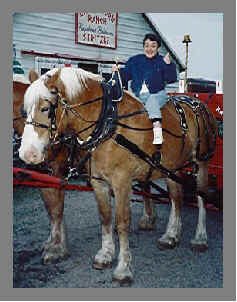 myself further toward Tad’s shoulders, and sit up. Triumph! I did it!
I did it, that is, with a considerable boost up. There were witnesses to the fact that I didn’t do it all by myself. But that doesn’t diminish the accomplishment. It just spreads the satisfaction around to more people. WE did it.
That’s not the first boost up I’ve had. A mere fraction of the list would include: My brother who carried me up and down the steps in grade-school until I could manage them alone. Friends who carried my cornet to and from the bus so I could practice at home. My parents who never told me I couldn’t do what I had an idea to do. Doctors whose surgical skill coaxed an amazing amount of mobility out of this crippled body. During those marvelous years among the Kimyal people in Irian Jaya, Indonesia, there were the Kimyal friends who carried me for hours in a special litter over narrow mountain trails. Now there are friends who help me in numerous ways, from doing massage to shopping to pulling weeds to … anything.
As wonderful as family and friends are, though, my experience is that all of us together still aren’t enough to get me on top of the PPS mountain. We need my supreme booster-upper, God. He’s always available to do it. And smiles with us at the triumph.
List of Elinor’s stories || Main page, “Our Own Stories”
Standing — With Confidence
November, 1999
“She was the first polio patient of 1952 at St. Luke’s hospital in Spokane,” Mr. Carper said. I hadn’t known that. I knew that I was hospitalized in January, but didn’t know I had that special distinction until Mr. Carper mentioned it when he came to speak to our Polio Outreach of Spokane meeting. He was the physical therapist at St. Luke’s hospital in 1952. I was just five years old, but I have clear memories of snow falling as my dad tried to walk quickly yet carefully as he carried me up the sidewalk to the hospital’s emergency entrance.
“Hurry, Daddy. I can’t breathe.”
The next thing I remember was waking up in the white world of isolation curtains. A pull-string to call a nurse was pinned to the bed near my head, but my arms wouldn’t move to reach and pull it. I couldn’t move anything but my eyes, as they took in the strangeness of it all.
Mr. Carper also told another story I hadn’t remembered: “Elinor was crawling on the exercise mat,” he said, “and I told her, ‘You look like a snake, crawling like that.’ ‘I do not!’ she countered. ‘Yes you do.’ ‘No I don’t! Snakes don’t crawl with arms and legs.’ ‘How do they crawl, then?’
After some contemplation, Elinor replied, ‘They crawl with their all-together. Except their eyes.’”
Hearing that story made me smile because it and my own memories of those hospital days, as I reflect upon them, show me a little girl who had a confident self-identity. An identity that stayed intact while growing up visibly different from children who could run, jump, ride a bike, walk without a “galumph,” bat a baseball and carry their own books to school.
As I rub shoulders with other polio survivors in our support group or on the Internet, I see that not all of us came through this devastating disease with such confidence — and no wonder. Some of us were teased unmercifully at school or shunned by people who didn’t know how to react to someone who is nonstandard.
So what gave me the confidence of a positive personhood? By what power could I refuse to internalize society’s insults, rebuffs and mis-descriptions of me? I believe the answer to that has it’s groundings in those same early months in the hospital after getting polio.
My daddy, like the father of any five-year old girl from a happy home, was my protector and the one who made bad things all better again. Then polio struck and daddy couldn’t be there in the hospital to help and protect. He couldn’t be there when I was all alone and frightened, feeling life slip away. He couldn’t help when my lungs finally lost the strength to pump air any more.
My daddy wasn’t there, but he had taught me that God was always with me, would never leave me, and could help when no one else could. So, almost like an automatic reflex, that night when I was so frightened that my life was ending, with child-like simplicity I asked God to please help. He did. Immediately I felt peace and knew he was there, making 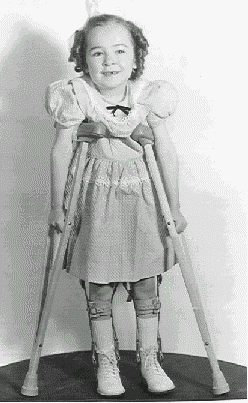 sure I was O.K. At that moment I knew that I mattered to God; I was important to him. He had a plan for me, he loved me and he would see me through, no matter what. He became my other, unlimited “Daddy.”
I suppose that can be seen as pretty incredible insight for a five-year old. When you look at it, though, it’s actually quite simple. And there in the hospital, as “the Sunday School lady” came every week to each room with her flannel graph board and told Bible stories about Jesus, my trust in his love and my knowledge of his smile on me became firmly anchored in his own words.
So, by the time I left the hospital, I was standing confidently, not only on the outside but on the inside as well. My identity was firmly rooted in God’s statement of his love for me, and nothing has or ever can shake that.
“Who shall separate us from the love of Christ? Shall trouble or hardship ….? No, in all these things we are more than conquerors through him who loved us.”
Romans 8:35-39 ____________________
If you want to discuss the concept of this article with Elinor, she would be happy to hear from you.
This photo is of 6 Yr. old Elinor Young and was given to her by Emery Carper the night he spoke at the Polio Outreach of Spokane meeting.
List of Elinor’s stories || Main page, “Our Own Stories”
Caring For Mom
November, 2001
I was overseas in a remote, primitive part of the world when my father died in 1975. There was no way I could get back to the States in time for the funeral. In fact, I got the telegram on the day of the funeral, three days after it was sent. It was read to me by radio from the coast. I was a missionary in the middle of Irian Jaya, Indonesia, the Indonesian half of New Guinea. Mom’s last letter had said that Dad was doing very well. The surgeon thought he got all the cancer; Dad was home and healing. I hadn’t expected this.
Mom, at the comparatively young age of 62, was a widow. It wasn’t long before I realized that though Mom was doing fine at this point, when she became elderly she might need to be cared for. I promised myself that, if that happened, I would return to the States and provide that care. It seemed only right. I was the only unmarried one of Mom’s five children; my siblings had other family obligations. I believed that God’s command to honor my parents meant more than just saying I loved my mother, and more than just providing for her physical needs in the ways that helped her feel loved and cared for. It also meant providing the emotional support she would need in her old age.
Mom and I shared a unique, mutual knowledge of our hearts and souls. It was a tie borne out of the long hours Mom spent on this five, then six-year old daughter, daily doing the routines the physical therapist had said were the only hope of coaxing function back into my polio-ravaged body. It was a connection nurtured by the daily letters Mom wrote to me each three-month stretch of time I spent in the Shriner’s hospital for my various surgeries from the age of nine to thirteen. It was a profound awareness deepened by my realization, as I grew into adulthood, of the extra sacrifices of time, money, and energy my parents paid to launch me into independence. With deep gratefulness I saw that letting me go was accomplished not only with pride but also with great courage as my parents conquered their fears that I was going far too far away for them to rescue me if I got into a situation I couldn’t handle. Especially when I went half a world away, into a primitive culture of (in their minds) unknown dangers. Yet Mom and Dad understood and shared the same level of commitment and love for the Lord that had led me to become a missionary.
I had been in Irian Jaya only a year when Dad died. Widowed mother and single daughter developed an even deeper, almost intuitive soul to soul recognition as we shared not only stories of events, but also our hearts in the weekly letters that crossed the Pacific ocean over the next sixteen years.
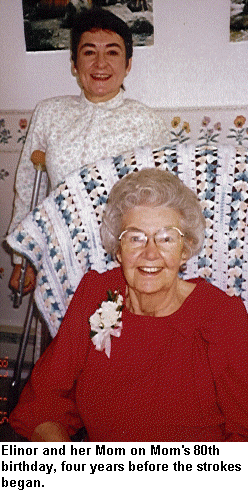 Then, in August of 1991, post-polio syndrome forced me back to the United States. I progressively weakened until I needed a respirator and couldn’t drive, cook, keep a house or walk more than a few steps. Mom became my caretaker. That had not been my plan.
However, in October 1996, I went to Futures Unlimited, Inc., a clinic in Mississippi, and came back walking, breathing, able to drive, cook and think again. While I was gone, Mom had the first of a long series of small strokes that were to continue for the next five years. So, when I returned from Mississippi, our roles were reversed; I was Mom’s caretaker. Now the picture was right. But as more and more tiny strokes robbed increasingly more of Mom’s physical abilities and caused her ever deepening dementia, it became impossible for me to care for her at home, even with a team of paid daily caretakers. I was physically much better than I had been before Futures, but I still had post-polio and had limited strength and energy. I was becoming impossibly exhausted. Mom needed 24-hour care. Twice she fell out of bed over night, and I couldn’t lift her back in. Even with what my siblings could contribute, the cost of ’round-the-clock care was more than we could handle.
We had no choice but to put Mom in an adult family home. I could still visit daily, but it wasn’t the same for Mom. Mom begged to go home, and in her child-like dementia couldn’t understand why she could not be with me. Again, it wasn’t supposed to be this way. I cried and grieved. I wanted more than anything to care for Mom at home, but I couldn’t. It was an absolute impossibility. My heart had not known such pain.
How would I handle this? To curse the polio would do no one any good, and would in fact curse the very thing that had forged the depth of my relationship with Mom. The Bible tells the story about an ancient man, Job and his wife. They suffered the huge bereavement of all their children and property in circumstances beyond their control. She said, “Curse God and die.” He said, “Though he slay me, yet will I trust him.” In addition to his loss, Job suffered painful boils and prolonged scathing wrongful accusations from friends who blamed his suffering on his own supposed character flaws. Through it all Job did not deny the pain. He cried. He complained to God. He demanded an answer. But he held on to God, and in the end, God came through. Not with a miracle, but with the peace of His presence, a greater understanding of His ways, with personal vindication of Job’s righteousness and a new full and happy future.
That certain knowledge that God, who is good and just, is in control is what got me through, too. I knew that one day both Mom and I would see the whole picture, and would see that our small dark shadow highlighted the glory of the story God is painting. Mom got to see it first. She passed into Heaven on April 1, 2001, at the age of 89.
Though I still grieve her loss, I am at peace in the assurance that with everything I had, I honored both my mother and my God. ________________________________
Elinor welcomes your comments.
List of Elinor’s stories || Main page, “Our Own Stories”
 More Than A Piggy Bank
May, 2002
I don’t know that Grandma had anything profound in mind when she gave me the piggybank. I was plus or minus ten years old. It was just a cute gift for her name-sake grandchild—and maybe a subconscious reminder of financial responsibility from this survivor of the Great Depression. On the other hand, maybe Grandma did have something deeper in mind. Boldly painted on the side of the piggy-bank is “For My Trip to Europe.” Did Grandma pay special attention to those words, or was she just attracted to the cute pig? A mere four inches long, realistically it couldn’t hold much money for such a trip.
Thinking about it, one could say that the words were either a cruel joke or dream-makers. When Grandma gave me the piggybank, polio had already damaged my body from ever again being able to walk normally, let alone traipse around the world. “For My Trip to Europe”? Not possible, many would have said. I doubt that Grandma had any idea that her cute little gift sparked a dream in me. A challenge. A secret I kept to myself, knowing how it would be seen by others—”impossible.”
Every summer when Grandma came to visit, she brought me and my siblings each a crisp two-dollar bill. Not two ones, but the more rare two-dollar bill. We five children of a farm couple were comfortable and happy, but spare cash was rare. Grandma’s two-dollar bills were a high event! Each summer I carefully folded mine and stuffed it through the slot on my piggybank’s back. Once in awhile I acquired a coin or two to put in, too. For my trip to Europe.
As big as that dream seemed to be, an even bigger one was growing in my heart. In that soft, sure way that only He has, God was beginning to form in me what some would term a “calling.” I began to feel more and more clearly that he wanted me to be a missionary some day. Could it be? By the time I was thirteen, I knew for sure that was God’s plan. A big dream for a young girl who wore braces and used crutches. But why stop with just a trip to Europe? Why just one “impossible” dream?
I did get my trip to Europe a few years after Grandma died. I was in college and no longer needed either braces or crutches. One year the college offered a January Term course of spending the month in Spain and Portugal. The cost was the exact amount of extra money I had from my scholarships and grants that year. A chunk of my spending money came from … you guessed it … my piggybank. Not wanting to break it, I turned it upside down, and with a knife blade, great care and patience, I managed to extract all those two-dollar bills and the few coins. Thanks for the money, Grandma. And for the dream. Thank you, Lord, for making a way for it to happen.
God also gave me His bigger dream for me. I spent seventeen wonderful years as a missionary in a remote, mountainous, primitive area of Irian Jaya (West Papua), Indonesia before post-polio syndrome brought me back to America.
So is that the end of the dreams? No. Grandma’s gift of the piggybank began to teach me what God has reinforced in my life over and over. My body has limitations– now even more than before. Not only am I back in braces and once again need crutches, but also I’m weaker than I was when I lived out those former dreams. But limitations and weakness are no barrier to God. In His hands they are just the dark backdrop that shows more brilliantly the light of what He can do. He has planted some new dreams in my heart. They seem to be a stretch, given my body. I look forward to seeing how God will pull these off!
List of Elinor’s stories || Main page, “Our Own Stories”

Who Is Elinor?
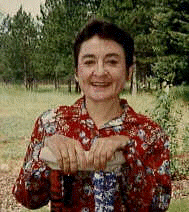 “I had Polio at age 5 in 1952. I was initially in St. Luke’s Hospital, Spokane for 7 months, then spent two years in out-patient therapy. I had several stays in Shriner’s Hospital, Spokane from age 9 to 14.
17 years of my life were spent in Irian Jaya, Indonesia, as a missionary to a remote interior mountain tribe. I was “officially” a linguist, learning and analyzing the Kimyal language and translating the Bible, but of necessity did everything from stitching wounds, treating burns and tube-feeding babies to air-traffic controlling for our grass-and-gravel strip and being economic consultant for a people transitioning from barter to currency. A major PPS “crash” forced me back to the States in August ’91. I was immediately diagnosed and continued to deteriorate so rapidly that return to Irian Jaya was impossible. Thanks to treatment at Futures Unlimited, Inc., I am much better now, but still need the conveniences and medical help available in the States. I am webmaster for Polio Experience Network, am a speaker, write and teach Bible studies and enjoy family and friends.”

Copyright Information:
None of the articles or photos on this page are in the public domain; permission to use them for public (profit) or private (non-profit) publication must be obtained from the author, who maintains copyright. Normally, permission for non-profit publication will be given. Please contact Elinor Young. Private use, i.e. printing a copy for yourself, family or friends may be done without permission. If in doubt, please ask. Thank you!

Any comments, questions or suggestions? Click here: 
Copyright © Polio Experience Network, 1994-2003. All rights reserved.
For some graphics sources, see P.E.N. main page.
Revised: August 30, 2004.