
|
|
||

Also
In This Issue:
Web Finds
Shoe exchange
Exercise
“The Role of Activity,”
by James C. Agre
The P.E.N. & ink Link
“Our Friend Edie Bradley”
“Caring For Mom,”
by Elinor Young
“Living With Disability: Self, Family or Friend,”
by Dave Graham
P.O.S. Library
Our Offer (for a mailed subscription)
Copyright information
________
________
 Polio Experience Network home page

“P.E.N. & ink” newsletter home page
? What is post-polio syndrome?
 Our Own Stories
 Students – For your research paper
 Futures Unlimited, Inc. “Hope for the future.”
Meeting  s for your support group
 Where Can I Find a Support Group?
 Links: Polio People and Places on the Internet
 Mail-out library
 PolioVaccine
 Conferences and other Announcements
 – home of “Air Travel Tips for the Wheelchair or Scooter User”
 Polio Outreach of Spokane
There are four basic types of footwear used in the treatment of PPS:
1. Shoes
. Choosing the right shoe in the right size is the first step.
2. Shoe modifications
. Shoes can be modified in a variety of ways to accommodate just about any foot.
3. Orthoses.
These are sometimes called inserts or insoles or even orthotics, but the proper term in the world of prescription footwear is orthoses (singular is “orthosis”). These are most often custom-made from a model of your foot.
4. Custom-made shoes.
Because shoes come in such a variety of shapes and sizes and can be modified in many ways, custom-made shoes are needed only in cases of severe foot deformities.
Let’s discuss these in a little more detail.
Shoes
The most common type of shoe used for people with PPS is called an in-depth shoe. It’s called an in-depth shoe because it has 1/4 to 3/8-inch more depth throughout the shoe to accommodate an orthosis. A lot of today’s athletic shoes can be considered in-depth shoes because they have removable insoles and therefore some extra depth. In-depth shoes also have other important characteristics that are helpful for people with foot problems, including:
Strong counter.
This refers to the back part of the shoe that fits around the heel. A strong counter helps control a varus heel and provides stability for the heel area. Deep toe box. The toe box is the front part of the shoe where your toes are. The extra depth provides plenty of room for a forefoot valgus or for hammertoes.
Shock-absorbing sole.
This provides the needed shock absorption we talked about earlier.
Removable insole.
Most in-depth shoes have a removable insole which can also provide shock absorption or can be replaced with a custom-made orthosis.
Wide range of sizes.
Most regular shoes you can get at a shoe store come in a limited range of sizes and only one (medium) width. (This is usually a B for women and a D for men.) In-depth shoes come in a greater range of sizes and in widths from very narrow (AAA) to very wide (EEEEE).
Heat moldable.
Some in-depth shoes are lined with a material that allows them to be molded when heat is applied.
A word about shoe fitting
– If you have foot problems, it’s important that you have a pedorthist or other professional shoe fitter help you get the right fit. They can help you get the right size (length and width) and shape for your foot. And remember – shoe sizes vary by style and manufacturer. You can have your feet measured, but this only gives you a guideline for what size to start with. The right size is the one that fits your foot!
Shoe Modifications
There are a variety of shoe modifications available for PPS. Here are some of the most common:
Flares.
This is when a piece of material is added onto the side of the sole to help control the varus heel. It might be added only to the heel area or it could go all the way along the side of the shoe, and will help prevent the feeling that your foot is falling off the side of the shoe. When it is built on the outside of the shoe it is called a lateral flare. A flare can also be built on the inside of the shoe for people with the opposite problem; this is called a medial flare. A flare also gives you a greater surface area that is in contact with the ground and will help you feel more stable.
Heel wedge.
This is another way to help control a varus heel. A wedge of sole material is inserted to make the sole better match the slantedness of the heel.
Fiberglass lateral counter.
A piece of fiberglass can be added to the outside portion of the counter to further control a varus heel.
Cushion heel.
A wedge of shock absorbing material can be added at the heel area to provide additional shock absorption for the heel area.
Rocker sole.
This is a specially shaped sole that helps your foot to “rock” from heel to toe during the normal course of walking. Most walking shoes are made with a rocker sole, but one can be added to other shoes. Not only does it help with walking, but when shaped properly it also helps to take pressure off the metatarsal heads.
Orthoses
Custom-made foot orthoses are made from a model of your foot, so they match up to the contours of your foot exactly. This is called “total contact” and is especially helpful for eliminating areas of excess pressure — the total contact evens out the pressure over the entire surface of your foot. An orthosis also provides an extra layer of shock absorption and can have special materials added to further customize it. These include: metatarsal pads to relieve pressure on the metatarsals; a soft, spongy material which can be added to specific problem areas to provide extra cushioning; firmer materials to help control varus heel and valgus forefoot; even a heel extension can be built into an orthosis.
Where to Get Footwear
There are several places where you can get prescription footwear (sometimes still referred to as “orthopedic shoes”). These include podiatrists, orthotists, specialty shoe stores, shoemakers or shoe repair people, and pedorthists. Podiatrists tend to focus on orthoses; they don’t usually have shoes or do shoe modifications. An orthotist specializes in braces, and shoe stores only offer shoes. If you can still find a shoemaker, they tend to focus more on repairs but sometimes can do modifications.
The best person to go to for the complete range of shoes, modifications and orthoses is a Board Certified Pedorthist. This person will have the initials “C.Ped.” after his or her name, and this tells you that he or she has received training in the field of pedorthics, has passed a comprehensive examination, and keeps up to date on the latest developments in the field.
A pedorthist is like a pharmacist for footwear; he or she works from a physician’s written prescription. A pedorthist is trained in foot anatomy, diseases affecting the foot, shoe construction, materials, modifications, and orthoses.
Usually pedorthists have offices that work like doctor’s offices where you make an appointment.
Your pedorthist will perform a foot examination, talk to you about your foot problems, and discuss your footwear needs. He or she doesn’t diagnose problems but can often help the physician to figure out the best combination of shoes, modifications, and orthoses that you might need. Pedorthists maintain an inventory of shoes, and can special order whatever type of shoe you might need. A full-service facility will also have a lab where shoe modifications are done and orthoses are made.
Follow-up is encouraged – often there may be adjustments or modifications necessary once you have worn your footwear for a while. A pedorthist might also be able to spot a problem and make a recommendation for a correction before it becomes a serious problem. As your PPS changes, your feet and footwear needs may also change, so your pedorthist just might become a regular member of your health care team.
The cost of prescription footwear varies depending on what you need. Most pedorthists don’t charge for office calls or follow-up – the cost is built into the footwear. Prices for in-depth shoes vary from approximately $60 for a simple athletic or walking shoe to $200-$250 for a heat-moldable shoe.
Custom-made shoes begin at about $350 a pair. The cost of external shoe modifications start at about $20 for simpler modifications such as a heel elevation, and range to $90-$130 for a more complicated modification such as custom rocker soles. Orthoses range from $200 to $450 a pair. Some insurance companies cover prescription footwear, to varying degrees, if the physician provides a written prescription.
_____________________________
Dennis Janisse had polio himself and is a Clinical Assistant Professor in the Department of Physical Medicine and Rehabilitation at the Medical College of Wisconsin and the Director of Pedorthic Education for P.W. Minor & Son, Batavia, NY. He teaches pedorthics courses at Northwestern University Medical School, Ball State University School of Medicine and the Medical College of Wisconsin.
From the Website of Post-Polio Resource Group of Southeastern Wisconsin
.
Permission to reprint must be obtained from this source. Originally printed in the PPRG “Spirit” newsletter, June, 1999.

 WEB FINDS
As a follow-up to the article above, check out these sites for information about mismatched shoe size purchase and exchange
:
NATIONAL ODD SHOE EXCHANGE is what its name implies. At this site you can find the mate to one of your shoes in the other size you need. There is a membership fee of $25.00. Telephone
(480) 892-3484; Fax: (480) 892-3568
NORDSTROM’s department stores will allow you to buy two shoes of different sizes and pay only the price of one pair. It is said that the original Mrs. Nordstrom had polio and established this policy. They will ship to your home if you cannot get to a store. Click here to enquire about using this service, or phone (1-800-285-5800).
At SoleMates you can e-mail others and arrange to buy shoes together, or register and wait for a ‘SoleMate” to contact you. This site also lists store locations, mostly in Ontaria, Canada. Telephone (905) 829-0505; Fax (905) 829-5199
THE ONE SHOE CREW. Service Description: 1. Attempts to match people of similar ages and tastes in shoe styles who have exact opposite shoe-size. 2. Provides new, unused, shoes for those who need just one shoe. 3. Information on shoes items, braces, handicapped clothing.
As a follow-up to the following article about exercise, see these sites:
“Non-Fatiguing General Conditioning Exercise Program (The 20% Rule),” by Stanley K. Yarnell, MD, Saint Mary’s Medical Center, San Francisco, California.
“GENTLE FITNESS,” an exercise video for people with PPS and other fatigue or pain causing conditions may be ordered at this site.
“Tips and exercises,” from an article by Mary Clarke Atwood written for the Rancho Los Amigos PPS Group Newsletter.
“WARM WATER POOL EXERCISE,” compiled by Mary Clarke Atwood, with editorial assistance by V. Duboucheron from “Pool Exercise – Principles and Guidelines for Polio Survivors,” by Robbie B. Leonard, M.S., P.T.

The Role of Activity
by James C. Agre, MD, PhD, Woodruff, Wisconsin
“To exercise or not to exercise,” is not the question for polio survivors; rather, the questions are these: what amount of exercise is enough? What amount is too much?
 There is no easy answer for all polio survivors, but we can make some general observations about inactivity and exercise.
Adverse Effects of Inactivity
Limitation in physical activity results in progressive deterioration of cardiovascular performance and efficiency; metabolic disturbances; difficulty in maintaining normal body weight; disturbed sympathetic nervous system activity; reduction in muscular strength and endurance; and possibly emotional disturbances.
Beneficial Effects of Regular Exercise
In contrast, beneficial physiologic adaptations to regular exercise include reduction in heart rate and blood pressure; morphologic changes in skeletal and cardiac muscle resulting in improved physical work capacity and an enhancement of cardiovascular efficiency in delivering oxygen and nutrients to the tissues; increased muscular endurance; increased myocardial vascularity; reduced blood coagulability; reduction in adiposity and increased lean body mass; increased cellular sensitivity to insulin; and favorable changes in blood lipids and cholesterol.
Beneficial psychological changes from regular exercise include reduction in muscular tension; improved sleep; and possible increased motivation for improving other health habits such as changes in diet (reduction in saturated fat consumption, for example) and cessation of cigarette smoking.
Evidence for Beneficial Effects of Exercise in Post-Polio Individuals
Studies have shown strengthening exercise, aerobic conditioning exercise, and ambulatory exercise to be beneficial.
Strengthening Exercise
– In Feldman and Soskolne’s study of six post-polio patients, the subjects performed non-fatiguing exercise three times per week for 24 weeks or longer. Strength either increased or remained the same in all muscles in all subjects except for one muscle in one subject that became weaker. The authors concluded that the strengthening exercise was, in general, very beneficial. Einarsson and Grimby studied 12 subjects who exercised three times per week for six weeks. The subjects performed intervals of strengthening exercise interspersed with rest breaks. All subjects became significantly stronger in the six-week period. Fillyaw and colleagues studied 17 subjects who exercised every other day for up to two years. The exercise intervals were interspersed with rest breaks. Over this period of time, all subjects gained significant strength.
At the University of Wisconsin, we conducted a 12-week study of muscle-strengthening exercise in seven post-polio subjects. Subjects exercised four times per week for 12 weeks at home. Exercise intervals were interspersed with rest breaks. After the 12-week program, the average increase in strength was 36%; also work capacity and endurance increased by 15% or more.
Aerobic and General Conditioning Exercise
– Four such studies have been performed. Jones and colleagues studied 37 post-polio subjects: 16 volunteered for the exercise program while 21 served as control subjects. The exercise subjects performed stationery bicycle exercise three times per week for 16 weeks. They began with bouts of exercise of 2-5 minutes on the bicycle with 1-minute rest breaks, progressing up to 15-30 minutes of exercise per session. After the program, the exercise subjects were found to have significant improvements in their aerobic power and their capacity to exercise. The control subjects did not change in this same time interval. Kriz and colleagues performed a similar study in 20 post-polio subjects (with 10 exercise and 10 control subjects); however, the exercise was upper-limb cycle ergometry (rather than lower-limb cycle ergometry). In this study, too, exercise subjects significantly increased their aerobic power and exercise capacity. Grimby and Einarsson studied 12 post-polio subjects who performed submaximal endurance and strength training twice weekly for six months. Activity was interspersed with rest breaks. Except for one, all subjects were significantly improved from the training program. The exception reported excessive fatigue with the training program. Grimby and Einarsson concluded that combined endurance training and submaximal strengthening exercise can be generally positive in post-polio individuals, but that overtraining can occur.
Prins and colleagues studied 13 post-polio subjects. Nine performed a swimming and aquatic strengthening exercise program and four were controls. Intervals of exercise were interspersed with intervals of rest. The authors reported significant improvements in strength and flexibility in the exercise subjects and no change in the control subjects.
Ambulatory Efficiency
— Dean and Ross studied 20 post-polio subjects. Thirteen were control subjects and seven performed treadmill walking exercise three times weekly for six weeks. The exercise was low-level, non-fatiguing, and not painful. After the six-week program, the exercise subjects walked more efficiently, while the control subjects showed no change. The study concluded that regular exercise could improve movement economy.
Exercise studies have shown that judicious exercise can improve muscle strength, range of motion, cardiorespiratory fitness, and efficiency of movement in some post-polio individuals. These benefits appear to occur when they keep their activity and exercise within reasonable limits to avoid excessive muscular fatigue or joint or muscle pain. Post-polio individuals should avoid activities that cause increasing muscle or joint pain or excessive fatigue, either during or after their exercise program because the performance of activity at too high a level may lead to overuse/overwork problems.
References
-
Feldman, R.M., & Soskolne, C.L. (1987). The use of non-fatiguing strengthening exercise in post-polio syndrome. In L.S. Halstead and D.O. Wiechers (Eds.) Research and clinical aspects of the late effects of poliomyelitis (pp. 335-341). White Plains, NY: March of Dimes Birth Defects Foundation.
-
Einarsson, G., & Grimby, G. (1987). Strengthening exercise program in post-polio patients. In L.S. Halstead and D.O. Wiechers (Eds.) Research and clinical aspects of the late effects of poliomyelitis (pp. 275-283). White Plains, NY: March of Dimes Birth Defects Foundation.
-
Fillyaw, M.J., Badger, G.J., Goodwin, G.D., Bradley, W.G., Fries, T.J., & Shulkla, A. (1991). The effects of long-term non-fatiguing resistance exercise in subjects with post-polio syndrome. Orthopedics, 14, 1253-1256.
-
Agre, J.C., Rodriquez, A.A., & Franke, T.M. (1997). Strength, endurance, and work capacity affect muscle strengthening exercise in postpolio subjects. Archives of Physical Medicine & Rehabilitation, 78, 681-686.
-
Jones, D.R., Speier, J., Canine, K., Owen, R., & Stull, A. (1989). Cardiorespiratory responses to aerobic training by patients with post-poliomyelitis sequelae. Journal of the American Medical Association, 261, 3255-3258.
-
Kriz, J.L., Jones, D.R., Speier, J.L., Canine, J.K., Owen, R.R., & Serfass, R.C. (1992). Cardiorespiratory responses to upper extremity aerobic training by post-polio subjects. Archives of Physical Medicine & Rehabilitation, 73, 49-54.
-
Grimby, G., & Einarsson, G. (1991). Post-polio management. Critical Reviews in Physical Rehabilitation Medicine, 2, 189-200.
-
Prins, J.H., Hartung, H., Merritt, D.J., Blancq, R.J., & Goebert, D.A. (1994). Effect of aquatic exercise training in persons with poliomyelitis disability. Sports Medicine, Training & Rehabilitation, 5, 29-39.
-
Dean, E., & Ross, J. (1991). Effect of modified aerobic training on movement energetics in polio survivors. Orthopedics, 14, 1243-1246.
____________________________
Reprinted from Polio Network News, Spring 1999 Vol. 15, No. 2 with permission of Gazette International Networking Institute, 4207 Lindell Blvd., #110, St. Louis, MO 63108-2915.
Obtained originally from www.post-polio.org/ipn/pnn4/l#activity. Moved to www.post-polio.org/ipn/pnn15-2/l#role
Reprint permission must be obtained from GINI.
 Be careful! Anything but very minimal exercise may harm some post-polio individuals. Don’t over-do it! Check with your physiatrist for proper assessment.
P.E.N. & ink Link
Wants shoe exchange partner: “We live in So. Calif. and my husband has 2 different shoe sizes due to polio. Each time we throw that “extra pair ” away it goes thru our minds…”can someone else use this pair of shoes”? We purchase work shoes, sandals, tennis shoes etc etc. as most people do. My husband wears a L–7 1/2 and R foot—size 11. I know it must be awfully hard to find a partner that can use the other pair…but anything is worth a try ! We thank you.” —Nancy (Email polionet@polionet.org for contact information.)
Wants email pal: “I have post polio and am new at the computer. I would like email. I am in late 50’s.” —Helen (Email polionet@polionet.org for her contact information.)
Says “thanks”: “I receive your publication and have gotten much help and satisfaction from it.” Agnes’s Website, “Raising Ten,” is worth checking out!

Our Friend Edie Bradley
Over the last few years our friend has hand-stitched for us some beautiful quilts.  We have offered the quilts as the grand prize in our raffle at Christmas time.
Edie Bradley contracted polio in 1945 as a child in Kalispel, Montana. It affected her lower spine and right leg. She was diagnosed with PPS five years ago and now spends most of time in her recliner where she accomplishes a great deal. Our friend knows it is important to keep her mind active so she has taught herself quilting and oil painting. She is even learning to play an electronic keyboard which she holds on her lap.
Edie is very artistic as reflected in her 3 to 4 month long quilting projects. They are absolutely beautiful. Some lucky person is going to win this year’s quilt. It is being shown at our support group meetings and is magnificent- completely hand-stitched on both sides.
In the years Edie has been quilting, she has created over 100 projects. She has won the blue ribbon at the fair and is now selling her projects for between $100 and $300, depending on size and pattern.
You can buy raffle tickets for just $1 each, or six tickets for $5. The drawing will be held at our Christmas luncheon in December. You do not have to be present to win. There are also other prizes offered in the raffle. All proceeds go to fund the work of Polio Experience Network. If you would like to participate, send your donation to:
P.E.N., S. 508 Shoreline Drive, Liberty Lake, WA 99019.
Your tickets will be sent to you in the mail. Winners will be notified by telephone.
Caring For Mom
By Elinor Young
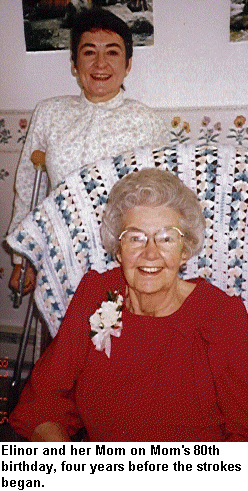 I was overseas in a remote, primitive part of the world when my father died in 1975. There was no way I could get back to the States in time for the funeral. In fact, I got the telegram on the day of the funeral, three days after it was sent. It was read to me by radio from the coast. I was a missionary in the middle of Irian Jaya, Indonesia, the Indonesian half of New Guinea. Mom’s last letter had said that Dad was doing very well. The surgeon thought he got all the cancer; Dad was home and healing. I hadn’t expected this.
Mom, at the comparatively young age of 62, was a widow. It wasn’t long before I realized that though Mom was doing fine at this point, when she became elderly she might need to be cared for. I promised myself that, if that happened, I would return to the States and provide that care. It seemed only right. I was the only unmarried one of Mom’s five children; my siblings had other family obligations. I believed that God’s command to honor my parents meant more than just saying I loved my mother, and more than just providing for her physical needs in the ways that helped her feel loved and cared for. It also meant providing the emotional support she would need in her old age.
Mom and I shared a unique, mutual knowledge of our hearts and souls. It was a tie borne out of the long hours Mom spent on this five, then six-year old daughter, daily doing the routines the physical therapist had said were the only hope of coaxing function back into my polio-ravaged body. It was a connection nurtured by the daily letters Mom wrote to me each three-month stretch of time I spent in the Shriner’s hospital for my various surgeries from the age of nine to thirteen. It was a profound awareness deepened by my realization, as I grew into adulthood, of the extra sacrifices of time, money, and energy my parents paid to launch me into independence. With deep gratefulness I saw that letting me go was accomplished not only with pride but also with great courage as my parents conquered their fears that I was going far too far away for them to rescue me if I got into a situation I couldn’t handle. Especially when I went half a world away, into a primitive culture of (in their minds) unknown dangers. Yet Mom and Dad understood and shared the same level of commitment and love for the Lord that had led me to become a missionary.
I had been in Irian Jaya only a year when Dad died. Widowed mother and single daughter developed an even deeper, almost intuitive soul to soul recognition as we shared not only stories of events, but also our hearts in the weekly letters that crossed the Pacific ocean over the next sixteen years.
Then, in August of 1991, post-polio syndrome forced me back to the United States. I progressively weakened until I needed a respirator and couldn’t drive, cook, keep a house or walk more than a few steps. Mom became my caretaker. That had not been my plan.
However, in October 1996, I went to Futures Unlimited, Inc., a clinic in Mississippi, and came back walking, breathing, able to drive, cook and think again. While I was gone, Mom had the first of a long series of small strokes that were to continue for the next five years. So, when I returned from Mississippi, our roles were reversed; I was Mom’s caretaker. Now the picture was right. But as more and more tiny strokes robbed increasingly more of Mom’s physical abilities and caused her ever deepening dementia, it became impossible for me to care for her at home, even with a team of paid daily caretakers. I was physically much better than I had been before Futures, but I still had post-polio and had limited strength and energy. I was becoming impossibly exhausted. Mom needed 24-hour care. Twice she fell out of bed over night, and I couldn’t lift her back in. Even with what my siblings could contribute, the cost of ’round-the-clock care was more than we could handle.
We had no choice but to put Mom in an adult family home. I could still visit daily, but it wasn’t the same for Mom. Mom begged to go home, and in her child-like dementia couldn’t understand why she could not be with me. Again, it wasn’t supposed to be this way. I cried and grieved. I wanted more than anything to care for Mom at home, but I couldn’t. It was an absolute impossibility. My heart had not known such pain.
How would I handle this? To curse the polio would do no one any good, and would in fact curse the very thing that had forged the depth of my relationship with Mom. The Bible tells the story about an ancient man, Job and his wife. They suffered the huge bereavement of all their children and property in circumstances beyond their control. She said, “Curse God and die.” He said, “Though he slay me, yet will I trust him.” In addition to his loss, Job suffered painful boils and prolonged scathing wrongful accusations from friends who blamed his suffering on his own supposed character flaws. Through it all Job did not deny the pain. He cried. He complained to God. He demanded an answer. But he held on to God, and in the end, God came through. Not with a miracle, but with the peace of His presence, a greater understanding of His ways, with personal vindication of Job’s righteousness and a new full and happy future.
That certain knowledge that God, who is good and just, is in control is what got me through, too. I knew that one day both Mom and I would see the whole picture, and would see that our small dark shadow highlighted the glory of the story God is painting. Mom got to see it first. She passed into Heaven on April 1, 2001, at the age of 89.
Though I still grieve her loss, I am at peace in the assurance that with everything I had, I honored both my mother and my God. ________________________________
Elinor welcomes your comments.
 Living With Disability: Self, Family or Friend
By Dave Graham
Because of my own disability I have learned a great deal about life changes, about coping and about human nature. I wanted this article to be helpful, short and to the point. With enough good material for a whole book I struggled to get it down on paper because this is such a sensitive subject. Most of us will have to deal with this stuff one day, if we haven’t already. So here, from three different perspectives, are some valuable hints for living with a disability.
SELF
(To the disabled individual)
Hint #1 – When faced with a new disability it is common for an individual to fear the worst. Try to avoid this trap by thinking clearly and objectively.
#2 – Another common pitfall is denial. In difficult times we must reach out for help.
#3 – Education about your particular disability is very important. That process goes beyond what the doctors will tell you. Go on-line and type in the name of your disability and conduct a search. Begin reading the wealth of information that pops up.
#4 – There are others out there who have experienced your disability. They can be very valuable to you at this critical time. Another resource may be a local support group. However, it takes time to be able to talk about one’s disability, and support groups often encourage discussion. If you are not ready, you can at least write down the contact number. Some day you may be ready. Another option is an on-line discussion group. It allows for communication without the vulnerability factor.
#5 – Pain is often part and parcel of a disability and certain people experience pain more acutely than others. Only you know what you are feeling. Try describing your pain to your spouse, caregiver or close loved one. That may be difficult, but to block them out of this part of the equation is asking for trouble. They may be your most important asset.
#6 – Finding the right doctor is important. A physician who specializes in rehab medicine is called a physiatrist and can be found under “Physical Medicine & Rehab” in the phone book.
#7 – You are about to find out just who your true friends are. You may have to make new ones. There are a lot of good ones out there.
#8 – Many of us were brought up to believe that it is inappropriate to burden others with our problems. However, this is no time to be stoical. People close to you can tell when you are hurting. Being long-suffering and uncomplaining only demonstrates that they are not important to you, as you are unwilling to discuss your disability with them. As in most of these hints, communication is crucial.
FAMILY
(To the disabled person’s family members)
Hint #1 – Don’t beat yourself up if your disabled loved one won’t talk to you about it. This is deeply personal stuff and communication may take some time.
#2 – It is important to educate yourself about your loved one’s disability. The Internet is the place to go for resources.
#3 – Finding a balanced role for yourself in your relationship with your disabled loved one can be difficult. Too much helping is as bad as not helping enough. Know that you will make mistakes. Improving communication will lessen those mistakes.
#4 – There are other caregivers out there who have experienced similar circumstances to yours. They can be very helpful. Consider a support group or Internet discussion group for family members of the disabled.
#5 – Help seek out the proper medical treatment. Be supportive and encouraging.
#6 – Our own anger and fear are common parts of this disability equation. Reach out for your own help.
#7 – Expect role changes and try to look for the positive issues in those changes.
#8 – You will have to focus on doing outside activities. It is easy to become a hermit as many of your friends will not call like they used to.
FRIENDS (To the disabled person’s friends)
Hint #1 – When people become disabled they are often unable to participate in shared activities any longer. A true friend will seek out new activities that will draw them together.
#2 – Don’t be put off by what you don’t know. Take the initiative to find out. Call your friend and ask the tough questions. Putting this off is putting off your friendship.
#3 – Educate yourself about the disability. Be sure that you have the correct name for the condition. Then go on-line.
#4 – Assume the role of enabler in your relationship. You be the driver. You make the contacts. You pay the bill. You suggest new activities then you make them happen. Just don’t push too hard.
#5 – In the case of the aged, if you are used to seeing your friend at a regular function and then one day they are not there, make a call on them. Do it right away. They may need your help.
Next issue I will write about how to act around the disabled, how to be politically correct, how to respond to their needs and how not to respond.
______________________
Dave Graham is Co-Director of ACCESS
Spokane and regularly does training and speaking on the subjects of disability, the ADA and Post-Polio Syndrome. Dave can be reached at david508@aol.com
***The information given in this newsletter is not meant to be medical, financial or legal advice and is not given by a medical or legal professional. We recommend that you seek appropriate professional counsel regarding any concerns.***
Polio Outreach of Spokane Library

Your resource for information on post-polio syndrome and disability issues.
P.O.S. maintains a large library of information on post-polio syndrome and disability issues.
The material is available by contacting our librarian, Darlene Hansen by phone at (509) 238-4512 or by E-mail at darleneh@cet.com
Some material is also available on our web-site at www.polionet.org/library/
and back issues of “P.E.N. & ink” at www.polionet.org/pen&ink/
Our Offer:
If you want to receive PEN & ink by normal mail, send a request with your mailing address to:
P.E.N. S. 508 Shoreline Drive
Liberty Lake, WA 99019
We would appreciate a donation for printing and mailing costs, if you are able to do so. We have no source of funding other than our readers.