
P.E.N. & ink Link
11 Reasons for Liking a Wheelchair
An Announcement For Our Friends
Our Offer (for snail-mail subscription)
Copyright information
When Herbs, Drugs and Other Things Don’t Mix 
by Elinor Young. Not an expert, but a learner.
Are you part of the following statistics? I am. According to the American Dietetic Association’s new nationwide public opinion survey, Nutrition and You: Trends 2000, 49% of American adults take vitamin or mineral supplements every day, and 12% use herbal supplements every day.1 I suspect that, compared to the general population, a higher percentage of us who are living with post-polio syndrome take supplements. We are very alert to whatever will help keep our bodies tuned to their personal best. After some years of experimenting, I take a specific variety of supplements which, I believe, are one part of what is keeping my health strong.
That the silver lining can sometimes hide a cloud, however. In some instances, a supplement may work against us. Take herbal or botanical supplements, for example. An herb relies on the joint action of all of the elements in the plant, so that together they can do more than each could do individually. One herb could contain thousands of compounds. These work together in a person’s body. As a result, the effects are not always seen right away, and may be subtle. A pharmaceutical drug, on the other hand, is one or two isolated elements which are stronger, more targeted and has a more rapid effect. It is formulated to hit one specific problem, hit it quickly and with force. It is when the actions of the herb and the drug too precisely overlap or conflict with each other that we can get into trouble.
But there can also be conflicts among vitamins and minerals. In fact, we need to be aware of conflicts among all four groups—drugs, vitamins, minerals and herbals. I will give some examples, then some pointers on where to find helpful information on this subject. Remember, this is not to be taken as professional medical advice! Check everything with your physician.
Echinacea
This popular infection fighter might, according to Germany’s Commission E, over stimulate immunity and should not be used by people with autoimmune diseases such as multiple sclerosis, lupus or tuberculosis.2
St. John’s Wort
This herb alters certain brain chemicals that affect mood. Use it with caution if you are taking an MAO inhibiter or a prescription anti-depressant. In fact, it is best not to take it under these circumstances, unless your physician tells you that it is all right in your case.
Licorice
, Mistletoe and Eleuthero These should all be avoided by people taking drugs for high blood pressure. Not all “licorice” candies actually contain the herb. Listing it as an ingredient on the candy’s packaging is not a requirement. Contact the manufacturer if you need to know for sure.
Garlic
The blood-thinning action of garlic can be dangerous when you take it in high-potency amounts and are also taking prescription blood thinners or are about to have surgery. Consult with your doctor about this.
Ginkgo
Another herb with blood-thinning effects, its use should be approached with caution by people taking a prescription anticoagulant or even aspirin. Taken with Coumadin it could cause stroke.
Kava
Though the compounds in this herb are useful to help relieve stress, it is dangerous to take with a benzodiazepine. It should also not be mixed with any other tranquilizer or sedative or with alcohol.
Calcium
This can interfere with the absorption of iron, zinc, copper and manganese. You can take all of them the same day, but not at the same time of day.
MSM
The subject of a recent book, this supplement claims to relieve osteoarthritis pain. However, it may have a mild blood-thinning effect, so should be used with caution by people taking other blood thinners or aspirin.
Vitamin B6
Because of its positive effect on nerves, this is a popular vitamin with post-polio folk. However, large doses can cause nerve damage. If you experience numbness and tingling in the hands and feet while taking it, be suspicious! Two mg. of this vitamin should be enough as a daily supplement. The upper safe limit is 100 mg. unless you are told otherwise by your physician.
Before surgery
— The American Society of Anesthesiologists warn that two to three weeks before surgery, one should stop taking St. John’s wort and ginkgo biloba. Doctors added feverfew and ginseng to that list. These herbs could cause anesthetic to have a stronger effect or could cause problems with blood pressure and bleeding.3 At least a month before surgery, tell your doctor all the supplements you are taking so he can check them for possible complicating factors during surgery.
The above is not an exhaustive list. You would be wise to research the supplements you are taking to check out any possible conflicts among them or with any prescription drugs you are taking.
One place to start is your local pharmacist, but today’s pharmacists doesn’t have time for much extra research. Consumer’s Reports magazine conducted a small study, checking 25 pharmacists in six states to see if they knew that Coumadin and ginkgo biloba were dangerous to take together. 16 of the 25 gave wrong or incomplete advice. Four were unsure and told the customer to consult with their physician. Only five of the 25 directly warned against taking the two compounds together.4
There are some good resources for your own research. One is Guide to Popular Natural Products. It costs $29.95 in the USA, and can be ordered by calling 800-777-2295 or by going to Website http://www.factsandcomparisons.com/ProdPage.asp?ID=126&pf=&ps=&si=. For the Physicians’ Desk Reference for Herbal Medicines ($59.95), or 2000 PDR® for Nonprescription Drugs and Dietary Supplements ($49.95), phone 800-232-7379 or go to www.pdrbookstore.com for the Physicians’ Desk Reference. Another excellent resource would be The Complete German Commission E Monographs – Therapeutic Guide to Herbal Medicines, which you might be better off borrowing from your local library. At Amazon.com, the CD-ROM costs $89.10, while the book costs $149 to $165. A very good Website resource is “Rx List Herbal Monographs,” found at http://www.rxlist.com/alternative/.
Nutritional or dietary supplements can be of great benefit in helping us to maintain optimal health, but they need to be used carefully. Research yours, and stay well!
_________________________________
1. http://www.naturalhealthline.com/newsletter/15JAN00/survey/.
viewed 01/13/00.
2. The German Commission E is a group of researchers and clinicians in Germany who are the German equivalent of the U.S. Food and Drug Administration. Herbal medication has long been accepted in Europe as a legitimate form of therapy, even prescribed by doctors and covered by national health plans. Therefore, herbs are researched much more intensely in Europe than they are in the U.S. at the present time.
3. New York Times, July 6, 1999. “A Warning Not to Mix Surgery and Herbs.”
4. “Consumer Reports” magazine, vol. 64, No. 10 (October, 1999). Page 40, “Putting Druggists to the test.”
Other sources for this article included:
All About Herbs, by Hyla Cass, M.D., ©1999 by Hyla Cass. Published by Avery Publishing Group, Inc. “Prevention” magazines, August 1999; September 1999; and December 1999.
Bits and pieces of info gathered on my journey through PPS life.
 WEB FINDS
Do you know a friend in another state or country who needs to find a post-polio support group? Try our newest page, “Where Can I Find a Support Group?”.
For more information related to articles in this issue of P.E.N. & ink, try:
We are sometimes asked for help or information about post-polio syndrome and Social Security Disability Income. If you don’t know how to apply, if you did apply but were denied and want to know what to do next, or for other issues, check out the following Websites:
-
Harvest Center Table of Contents
(then click on appropriate links). Don’t miss on that same page, “Medical/Legal Consultations for SSDI.”
|
Sharman’s News I hope you all had a great New Year! We spent New Year’s Eve in Scottsdale, AZ, –playing with our new granddaughter, Courtney. I don’t know what we did for enjoyment before grandchildren. Little Kenny, our 2 1/2 year old grandson, is a source of constant entertainment. He is learning to cope with his feelings of love/protection/jealousy towards his new baby sister, Madelaine. I am looking forward to a warm Spring! The golf course below our house is presently covered with wet heavy snow, but I know that spring is just around the corner. I am also looking forward to the great meetings we have planned for the upcoming months. Much love from your friend,, Sharman |
||


-
Post-Polio Syndrome Resources, Social Security & Disabilities
. Be aware that some links are not the most up-to-date information.
Another question we are sometimes asked is, “Where can I find used medical equipment?” Try ABLEDATA’s Equipment Resale page.
Birthdays to Remember
Most of our polio survivors are over age fifty. With this maturity come some very important dates – windows of opportunity. In fact, failing to act on these opportunities may be hazardous to our financial and/or physical health. Here is a list of key dates.
w
Age 55. You can take a one-time exemption on the capitol gains profit tax on the sale of your home. You can also begin making penalty-free withdrawals from a company sponsored retirement plan if you retire, change employers or are fired. (not an I.R.A.)
w
Age 59 1/2. You can take withdrawals from any retirement plan or IRA (Individual Retirement Account) without penalty.
w
Age 60. A surviving spouse who is not disabled can now start collecting a reduced Social Security benefit, 71.5% of the amount paid at age 65.
w
Age 62. You can now collect your own Social Security. It is not the full amount that you would receive at age 65. There is a sliding scale which determines the amount.
w
Age 65. Here is the biggy. First, you can begin to receive Medicare. (Some disabled folks are able to receive Medicare much earlier) Next, you will be able to receive your Social Security benefit. There is now beginning a gradual shift from age 65. By 2027 the starting age will be 67.
w
Age 70 1/2. You must start withdrawing a required minimum from your retirement plan or IRA. You have until April 1 of that birthday year to begin.
Now it is here that I must make my disclaimer. I am no expert in these matters. This compilation is intended to give you reason to go talk to a Certified Financial Planner about your benefits. These people will counsel you so that you won’t miss those special opportunities. They can also give some very worthwhile tips. Example: Three months before your 65th birthday, start your Medicare application process to avoid delay in coverage. Also that is the time to look into Medigap coverage and decide about Medicare part A and Part B.
One other place to look for help is the SHIBA program. That is the state’s Senior Health Insurance Benefits Adviser.
Dave Graham – Editor
Life Is Different…But Life Is Good.
By Dave Graham
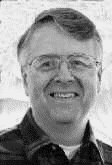 To know me was to know my disability. Unless you were blind, it was obvious that polio was not very kind to me. I had only known it one way. Polio came when I was ten months old. It left it’s scar for a lifetime. Because I was a baby, it seemed natural. As an adult, the ethics of my social strata required me to make my way, to get a job, earn a living and be a tax-paying contributor. I worked hard every business day for twenty-eight years. I paid my way. As a business man, I cussed the 30% tax that was wrenched from my pay check. I railed at the one dollar the government gave back in services for every two they extracted. I saw the government’s social programs as wasteful, rife with fraud and spawning dependency. I was politically conservative, a businessman, just right of center. Post-polio syndrome tends to change one’s perspective. In the very peak of my earning curve I was suddenly and most profoundly unable to work. Everything changed. I was forced to file for Social Security Disability! My wife had to go to work. I was officially retired at age 48. Years have passed since that transition, and I can report to you that life is good, but life is different. It took me some time to appreciate the finer things of this life style, but they were there nevertheless. I no longer wear a watch, a fixture that seemed to rule my past. From a lifestyle that seemed driven by dollars and time, I now appreciate a nicely kept yard and an afternoon nap. I have more real friends. At least I have time for them now. My political philosophy is built on a new perspective. I no longer look at all of the government’s social programs as being the scourge of the working man. I truly appreciate my wife and the contribution she makes in the support of our family. I have learned to cook. I can’t golf any more, but I’ve become an exceptional fisherman. I’m also an avid arm-chair sports fan and I know the players by name. I have a spiritual life now. Oh, I was a believer before, but somehow I never devoted the time to have a real relationship with my Creator and to worship Him.
Life is different… but life is good.
(From The Archives:
This article was originally printed in edition #12; May / June 1996)
Overheard at Polio Outreach of Spokane…
The October meeting was a very practical one! Connie Richards from the Spokane Police Department came to tell us how we could avoid becoming a victim of crime. One can quickly become a robbery victim, even in the middle of the day! Connie said, “It only takes seconds for a person to get in and out of your car, or minutes to get in and out of your home.” Then she stated, “Most crime is not against a person, but against property; things that can be sold for cash.” Connie warned, “Fifty percent of all burglaries occur through unlocked windows or doors.” Connie gave some pointers on what to do. She said, “If you are driving and you think you are being followed, drive past your house to a well-lit store or building. Then make noise.” She said, “If you are ever attacked, holler or make any noise to scare your attacker away.”
“To be safe,” Connie advised, “stay alert.”
The November meeting was a totally different subject. Jeanann Eckert, previously a respiratory therapist and now an acupuncturist, explained the theory and procedure of acupuncture as well as the use of herbs and massage. She explained the presence of channels in the body which have to stay clear. If one gets dammed or broken, you can experience pain or other unpleasant symptoms.
Jeananne emphasized, “Acupuncture, herbs, massage and other treatments normally called ‘alternative’ should be called ‘complementary’ medicine.” She believes that Western and Eastern treatments can work together to promote health and healing.

For sale
: Slightly used (but probably older) motorized wheelchairwith two motors; one above each back wheel. These can be engaged to drive the wheels or disengaged to allow hand operation. Has a horn. $300.00. Call Lyle Jurey, 509-928-6567. Please do NOT call after 8:00 p.m.
Good News
.. Free Shoes! If you’re a woman who can wear a B-width, left shoe size 7 – 8 and right shoe size 2 – 5, you are in luck! I have 31 pairs in a variety of styles (dress, casual and sport), all in excellent condition and would love for you to have them. The shoes are free, but I would appreciate your paying the shipping charges. Desire serious inquiries for bulk shipment only. Please call 210-479-2191 (evenings) or email bindman54@hotmail.com.
“I just “stumbled-onto” (the P.E.N.) web-site, and am, frankly, overwhelmed! I contracted polio in 1944, and began symptoms about, 1984. For a long time, my brother (now retired M.D.), struggled to find, SOMEONE, besides him, who knew ANYTHING about PPS. Thank you, again. As I near 70 it is suddenly, not as lonely !!!!” -E.S.
“I just wanted to let you know that I think you are doing a GREAT job! You have all the issues covered. I have been researching, looking for ways to help my mother who has been diagnosed with Post Polio Syndrom. I have found many good articles on your site. Thank you so much for your commitment to keep up the newsletters. May God bless all of you who are a part of this wonderful web site and newsletter.” – V.S.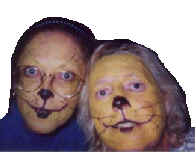
Do you
remember the story of Sylvia and Marilyn going up an escalator on their scooters? Sylvia sent us this photo of how they greeted trick-or-treaters this past Halloween. Are YOU brave enough to send us a crazy picture?

11 Reasons for Liking a Wheelchair
11.
When you enter a room you are always noticed. (you are usually the shortest)
10.
You can be around disabled people without feeling uncomfortable.
9.
Bar drunks hardly ever call you out to fight.
8.
People tell you so many of their troubles, that your own hardly seem to matter.
7.
When you bump into people they apologize as if it were their fault instead of telling you to watch where you’re going. (but I have had people say I need to stay within the speed zone)
6.
You can give righteous dirty looks to the non-disabled who park in “handicapped” parking spaces.
5.
Children find you fascinating (especially if you have a power one)
4.
When there is a cat burglar in the neighborhood you are never suspected.
3.
People call you an “inspiration” even if you are a slob.
2.
Your shoes last a lifetime if you just get them retopped occasionally.
1.
You never have to worry about becoming disabled and ending up in a wheelchair.
By Sylvia, a full time out-of-the-house; frequently in-house wheelchair user. [Found on the “Wheelchair Users Only” WEB site at: Used by permission.]
SEND US your own “10 Reasons to (or for) ______.” The best submissions will be included in future issues of P.E.N. & ink. Email the editor.
An Announcement For Our Friends
At Polio Experience Network
, we are constantly amazed at the people, information, resources and experiences that we enjoy as we serve in this capacity.
While our PPS’ers here in Eastern Washington State are, as a group, quite well informed and plugged-in, we are finding many others in our country not as fortunate.
Regularly we receive postal and e-mail inquiries about Post Polio Syndrome. As editor of PEN & iNk, I usually receive requests for the newsletter. We are adding a couple dozen new subscribers each issue. Our Librarian continues to send out packets of PPS information to individuals and their doctors. Many other inquiries come in off the discussion groups and e-mail bulletin boards.
We especially enjoy hearing from folks in distant countries. Our citizens are so blessed here in the United States because we have available health care. Many inquiries reflect just the opposite in some foreign lands . We end up being their only resource for information about PPS. Can you imagine how helpless they must feel not having professionals there when you desperately need them? I thank God for the Internet and the fact that we at P.E.N. are able to help these polio survivors if only in a detached way.
We want you to know that you play an extremely important role in the success of P.E.N. and the continuance of our services. Your donations and encouragement keep us going.
Last year we promised to keep you informed when our finances started to run low. And so I want to announce that in our next issue we will be enclosing a donation envelope. Thank you for your continued support and your prayers. Sharman, Elinor, Dave, Darlene and Faye
Our Offer:
If you want to receive P.E.N. & ink by normal mail, send a request with your mailing address to:
P.E.N. S. 508 Shoreline Drive
Liberty Lake, WA 99019
We would appreciate a donation for printing and mailing costs, but if you are not able to do that it doesn’t matter. If you want to a subscription, let us know.
